Ginkgo
Ginkgo biloba
Unity of image and mirror image, balance of polarities
Botany
Ginkgo biloba L. is a slow-growing, 10 to 40 m tall deciduous tree that can live for over 1000 years. It is the sole survivor of a genus that has scarcely changed for more than 150 million years, and the only extant representative of the family Ginkgoaceae. A species has been traceable for about 65 million years, whose fossil leaves are indistinguishable from those of today's Ginkgo — hence it is also called a “living fossil”. Originally native to Central Europe, it became extinct there due to the ice ages and survived in Asia, from where it was reintroduced.
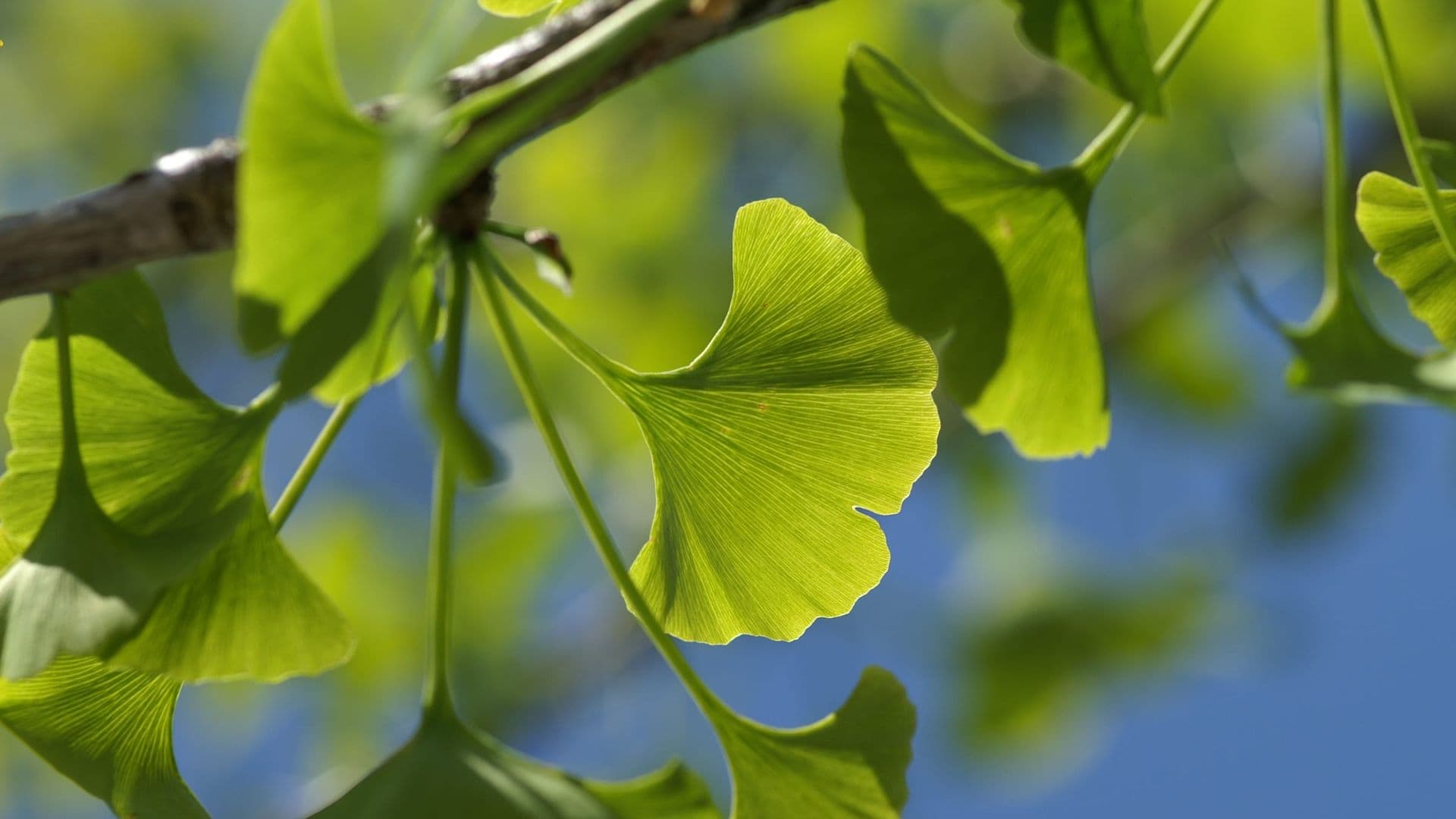
Characteristic are the leathery fan-shaped leaves, often clustered on the shoots. The leaf blade has no central vein and a special venation: the veins run parallel and fork in a forked manner without diminishing in thickness after the fork. The blade is often deeply notched — hence the species name “biloba”, two-lobed. The intensely green leaves turn bright yellow in autumn. Ginkgo biloba L. is dioecious: there are purely male and purely female trees. The inconspicuous flowers appear in spring; the tree must be 20 to 30 years old to flower. In autumn, mirabelle-sized seeds develop on female trees, which emit an unpleasant odour when ripe — which is why mostly only male trees are found in Central Europe.
Essence of the plant
Unity of image and mirror image, balance of polarities
Everything in nature is created, set in motion, and passes away through forces arising from the tension field between two poles. This law of polarity is fundamentally valid and evident; we find it in the opposites of day and night, male and female, youth and old age, and so on. Nevertheless, we repeatedly forget to incorporate this law of polarity into the practice of our daily lives.
Usually, one side of a matter is preferred and clung to, while the corresponding other side is rejected or fought against. This leads to a loss of dynamism and vital force, because this can only exist in the tension field of opposites that stand equally opposed or succeed each other in chronological sequence. In our culture, the causal-analytical thinking of the left brain hemisphere is overvalued and promoted, whereby the analog-synthetic thinking of the right hemisphere is neglected and atrophies. Over time, this inevitably results in a loss of vitality in the brain and a degeneration of its functions as a whole.
Ginkgo symbolises, with its bilobed leaf which unites the two poles – male and female – within itself, the unity and balance of polarities. As vital force is strongest in balance, the Ginkgo tree has very high vitality, demonstrating its enormous, unmatched resistance and regenerative power in the plant kingdom. This vitality regenerates the performance of the brain, that organ which uniquely contains both poles within our body.
Ginkgo biloba
Ginkgo
From shape to healing power
The two-lobed ginkgo leaf has always held great fascination for humankind. It serves as a motif for jewellery and ornaments, is depicted in visual arts, adorns valuable everyday objects, and appears in company logos. In the Goethe city of Weimar, the famous poem by the great poet about the ginkgo leaf accompanies us at every turn on souvenirs. The ginkgo leaf carries an aura of the extraordinary, for there is no other leaf even remotely comparable to it.
The ginkgo tree appears to be positioned in evolution at the transition between conifers and the more highly developed deciduous trees. Botanists refer to it as a living fossil because the ginkgo stems from a very ancient plant family of which this is the only surviving species. The ginkgo is arguably one of the most profound symbols from nature for the mystery of human existence. Human beings, a divided double entity; born of unity, called to unity. The division into two polar halves is a comprehensive characteristic of both humanity and nature, not just of the sexes.
Everything is subject to the same law of polarities, opposites that give rise to life as well as conflict and death. The split into polarities and their conflicts has a beginning. The Bible speaks of eating the fruit of the tree of knowledge of good and evil. This is a symbolic indication that the division, the loss of unity of the two poles of life, is rooted in consciousness and thought.
Mirroring this, the path back to unity is founded in a different, new consciousness, nourished by the fruits of the tree of life. Why does the two-lobed ginkgo leaf (Latin biloba = two-lobed) show us the essence of division and unity, when there are many other plants that in some way express the number two? The answer lies in the venation structure of the ginkgo leaf. To grasp its special nature, however, we must first consider the structure of venation as it usually occurs.
Evolutionarily simpler plants (monocotyledons) have leaves with parallel-running veins. More highly developed plants (dicotyledons) usually have leaves with a net-like branched vein structure; we recognise a main vein in the centre of the leaf, from which lateral veins branch out, and from these, smaller veins branch off again. Viewed overall, the picture often resembles a large river with tributaries and brooks. Sometimes leaf veins also have a mesh structure. In the ginkgo leaf, we find the exception of a strictly two-part forked branching pattern.
If we follow a vein from the leaf base outwards, we find at the branching point not a side branch of a smaller vein, but the original vein divides into two veins of exactly equal strength, and so on. This gives the vein branching the same pattern as when we graphically represent yes-no decision processes in the form of a tree diagram. Thus, if we go from the origin of the ginkgo leaf to the periphery, we follow a path of repeated splitting into two (= analysis); if we follow the reverse path, from the periphery to the origin, we follow a path of repeated unification of two (= synthesis). Given this profound structure of the venation, it might seem almost trivial to point out the striking similarity of the periphery of the two-lobed ginkgo leaf with a cross-section through the two cerebral hemispheres.
Wild collection
The ginkgo in its wild form is presumably native to China. Today it is cultivated worldwide as a cultural plant in parks and gardens as well as a street tree. Ginkgo for pharmaceutical purposes is cultivated on plantations in China, France and the USA.
Ceres uses ginkgo leaves from wild collection. The leaves are carefully harvested by hand in late summer before they turn yellow.
Traditional Use
Originally native to Asia, Ginkgo biloba L. is regarded as a particularly well-researched medicinal plant, attributed with properties that promote circulation (enhancement of microcirculation). By improving blood flow in the brain, it is believed to support cognitive performance in cases of memory weakness, as well as to help with tinnitus and dizziness (through improved circulation in the inner ear). The circulation-enhancing effects can be explained by relaxation of the blood vessels and an improvement in the fluidity of the blood. Further research is focusing on the extent to which the effects of preparations made from Ginkgo leaves are attributable to antioxidant effects against free radicals. Herbal medicine concentrates on the use of Ginkgo biloba L. in the production of standardised special extracts, primarily applied in disorders of the central nervous system and mild dementive illnesses. As with Ginkgo biloba L., it is apparent that medicinal plants cannot usually be assigned to a single therapeutic direction but should be considered holistically. For example, the area of application «headache» is found in both herbal medicine and homeopathy.
Sources
1. Hänsel, R. & Steinegger, E. Hänsel / Sticher Pharmakognosie Phytopharmazie. (Wissenschaftliche Verlagsgesellschaft GmbH, Stuttgart, Deutschland, 2015).
2. Hänsel, R., Keller, K., Rimpler, H. & Schneider, G. Hagers Handbuch der pharmazeutischen Praxis Band 5 Drogen E-O. (Springer-Verlag Berlin Heidelberg 1993, 1993).
3. Committee on Herbal Medicinal Products (HMPC). Assessment report on Ginkgo biloba L ., folium. EMA/HMPC/321095/2012 (2014).
4. BGA/BfArM (Kommission D). Ginkgo biloba. Bundesanzeiger 217 a, (1985).
5. Kalbermatten, R. & Kalbermatten, H. Pflanzliche Urtinkturen. (AT Verlag, Aarau, Schweiz, 2014).
6. Kalbermatten, R. Wesen und Signatur der Heilpflanzen. (AT Verlag, Aarau, Schweiz, 2016).
Ceres mortar process — gentle, cold and complete.
Freshly harvested, hand-picked, ground at room temperature and aged for years. No heating, no pressure - the plant's full vitality is preserved.