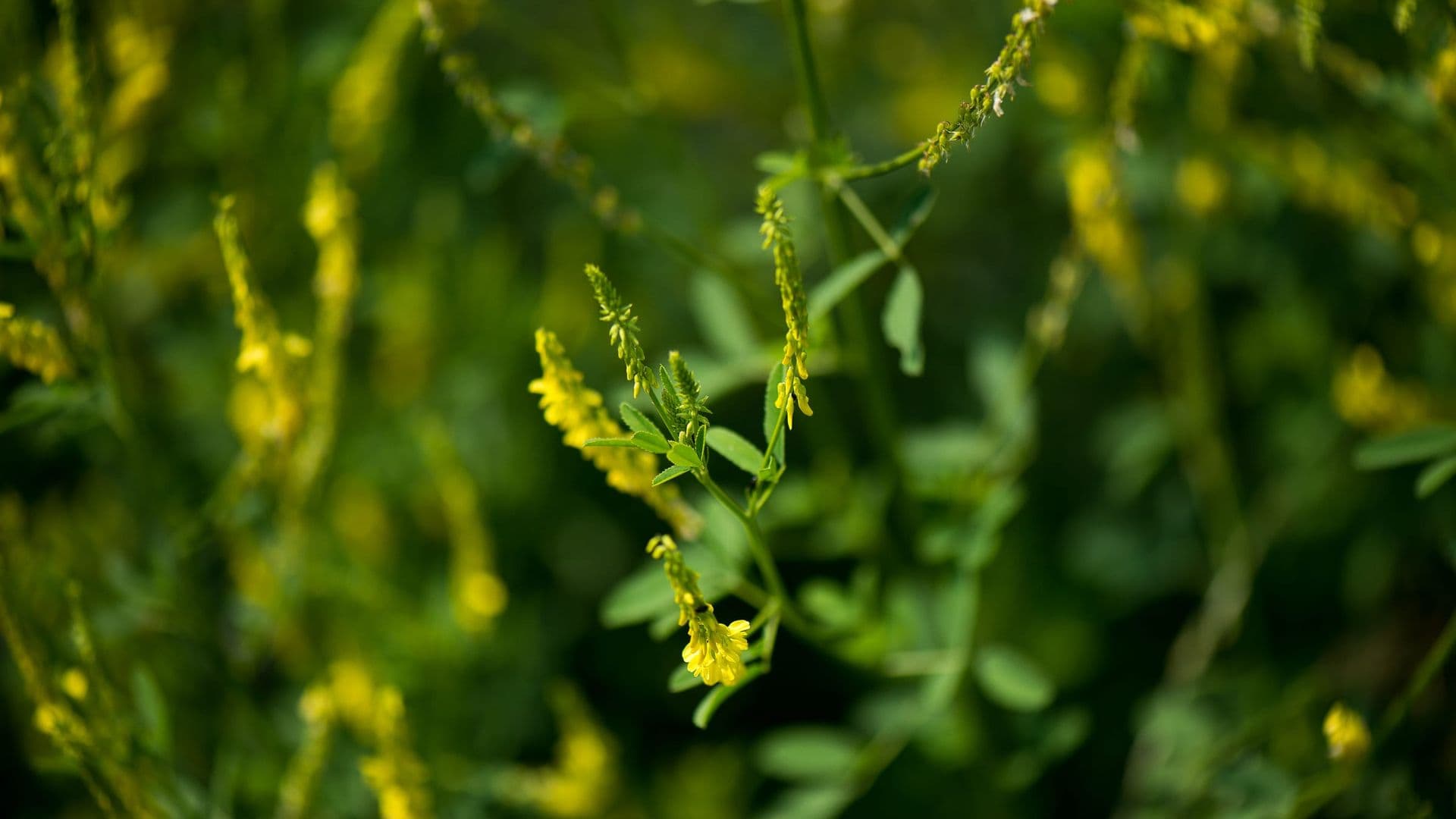
Melilot
Melilotus officinalis
Softening, dissolving, calming, warming
Botany
The common Melilot (Melilotus officinalis (L.) LAM) is a biennial plant that grows up to 200 cm tall. It belongs to the family of legumes (Fabaceae). From a branched taproot, many upright, angular, sturdy stems grow in the second year. The leaves are trifoliate — the leaflets broad-lanceolate to inversely ovate and serrated on the edges — they are relatively small in relation to the overall size of the plant, making them scarcely noticeable from a distance.
In the second year, Melilot flowers from May to September with small, yellow flowers that quickly fade, arranged in racemes 4–10 cm long with 30 to 70 flowers each. The flowers have the typical structure of a butterfly flower, with a standard, wings, and keel. Since the flowers on one raceme bloom successively, buds, open flowers, and developing fruits can be found simultaneously on a single raceme. The intense scent of coumarin is remarkable — the smell of drying woodruff and fresh hay.
Essence of the plant
Softening, dissolving, calming, warming
Yellow Sweet Clover develops a strong scent of fresh hay, mixed with a light honey note. In this composition, the plant reveals itself very directly and unabashedly. Under the spell of its fragrance, we feel comfortably relaxed and pleasantly soothed.
Let us recall a hot, sultry summer day! Breathing is heavy, every movement is strenuous in the heat, we feel listless and lacking energy, there is tension in the air, the atmosphere is “electric”. Then a cleansing summer thunderstorm breaks in, and shortly afterwards a relieving relaxation spreads; we can breathe freely again.
The air smells fresh and pure, the atmosphere has discharged, the temperature is pleasant again. Yellow Sweet Clover evokes this and similar images; it is the plant’s effect translated into picture. Yellow Sweet Clover has a dissolving essence, it allows the sluggish, slowed bodily fluids to flow again.
When tendencies to clumping and stagnation occur in body and soul, Yellow Sweet Clover acts softening and resolving. It has a specific effect on blood viscosity and improves, virtually liquefying blood thickened by an unhealthy lifestyle. Through its dissolving power, Yellow Sweet Clover also acts relaxing and calming.
Melilotus officinalis
Melilot
From shape to healing power
Yellow Sweet Clover belongs to the family of Leguminosae (Fabaceae) and is found in dry, rocky locations such as gravel pits, rubble sites, and verges. It grows up to 90 cm tall. The leaves are trifoliate, and the small yellow flowers appear in clusters of 30 to 70. Yellow Sweet Clover presents an extremely diffuse overall appearance: the countless small flowers, which also quickly lose their yellow colour and fade, the countless small leaves, and the highly branched stems.
Certainly, there are many other plants with very small flowers, but in those cases, the entire plant is small. Or there are other plants that have very many leaves and flowers, but then the whole plant is large, such as trees. There are hardly any other plants that achieve a rather stately size and yet have such small flowers and so many leaves. Another sign of dissolution is the remarkable fact that Yellow Sweet Clover produces smaller leaves in its second year than in its first, and that the flowers lose their yellow pigment and fade shortly after blooming.
However, to explain the most important characteristic of this dissolving essence, some knowledge about the chemical constituents of Yellow Sweet Clover must be conveyed. The plant has a high content of coumarin and its glycoside. Coumarins are volatile substances with an intense scent. For example, coumarins are responsible for the typical smell of fresh hay.
We all know that hay smells quite different from fresh grass. This suggests a chemical transformation process during drying. This involves the formation of the fragrant coumarins from an odourless precursor, the coumarin glycosides.
These are compounds composed of a coumarin molecule and a sugar molecule. During wilting, enzymes (glycosidases) are released that cleave the sugar from the coumarin glycosides, thereby releasing coumarin. This cleavage is thus a partial chemical dissolution. Most plants containing coumarin glycosides, such as grasses, do not smell of coumarin when fresh, meaning they contain no free coumarin but only its odourless glycoside.
The situation is quite different with Yellow Sweet Clover. This plant already has an intense coumarin scent (like fresh hay) in its fresh state. This means that the dissolving process, which normally begins only during wilting, takes effect in the plant at the flowering stage. It is also worth noting that coumarin itself is a substance embodying the principle of dissolution.
Coumarin reduces blood viscosity; it thins the blood. The most important medications for blood thinning, which are prescribed medically after embolisms, are chemical derivatives of coumarin. We therefore see that Yellow Sweet Clover, through a dissolving process, produces a substance with a dissolving effect already in its fresh state. This is, as mentioned, an exception and thus a very strong indication of the repeatedly mentioned essence of this plant.
Demeter cultivation
Yellow Sweet Clover is widespread in Europe and Western Asia and grows on dry, calcareous soils at pathsides, embankments, fallow land, and in gravel beds. It prefers sunny locations and is considered an indicator plant for calcareous, permeable soils.
Ceres uses Yellow Sweet Clover from Demeter cultivation. The flowering herb is harvested in early summer at the peak of bloom.
Traditional Use
Melilotus officinalis (L.) LAM, commonly known as sweet clover, is a well-known venous medicinal plant like horse chestnut (Aesculus hippocastanum). It is used not only internally but also externally in the form of ointments and suppositories for complaints related to chronic venous insufficiency. The plant is attributed with anti-oedematous and wound-healing-promoting effects by enhancing venous return and improving lymphatic kinetics. Areas of application include varicose veins, swelling, pain and a feeling of heaviness in the legs, haemorrhoids, as well as bruises, sprains and superficial haemorrhages. Spoiled Melilotus officinalis in hay, when fed to animals, leads to severe bleeding tendencies. This is due to the formation of dicumarol through mould infestation, a substance later discovered and not originally present in the plant. The identification of this compound led to the development of today’s synthetic vitamin K antagonists, whose blood-thinning effects are utilised in medicine and also in rodenticides.
Sources
1. Hänsel, R. & Steinegger, E. Hänsel / Sticher Pharmakognosie Phytopharmazie. (Wissenschaftliche Verlagsgesellschaft GmbH, Stuttgart, Deutschland, 2015).
2. BGA/BfArM (Kommission E). Meliloti herba (Steinkleekraut). Bundesanzeiger 50, (1986).
3. Committee on Herbal Medicinal Products (HMPC). Assessment report on Melilotus officinalis ( L .) Lam ., herba. EMA/HMPC/44165/2016 (2017).
4. BGA/BfArM (Kommission D). Melilotus officinalis. Bundesanzeiger 29 a, (1986).
5. Stahmann, M. A., Huebner, C. F. & Link, K. P. Studies on the Hemorrhagic Sweet Clover Disease. J Biol Chem 138, 513–527 (1941).
6. Bye, A. & King, H. K. The Biosynthesis of 4-Hydroxycoumarin and Dicoumarol by Aspergillus fumigatus Fresenius. Biochem J 117, 237–245 (1970).
7. Kalbermatten, R. & Kalbermatten, H. Pflanzliche Urtinkturen. (AT Verlag, Aarau, Schweiz, 2018).
8. Kalbermatten, R. Wesen und Signatur der Heilpflanzen. (AT Verlag, Aarau, Schweiz, 2016).
Ceres mortar process — gentle, cold and complete.
Freshly harvested, hand-picked, ground at room temperature and aged for years. No heating, no pressure - the plant's full vitality is preserved.