St John’s Wort
Hypericum perforatum
Light assimilation, strength to counter nervous sensitivity, stability
Botany
Hypericum perforatum L., St John's Wort, is a deciduous perennial widespread throughout Europe, typically found in rather dry and sunny locations. It belongs to the family of St John's Wort plants (Hypericaceae), grows up to 80 cm tall, and grows upright from its spindle-shaped root. The hard, woody stem is consistently two-edged — easily felt when sliding your fingers along it. In the upper part, it branches out, with lateral shoots growing diagonally upwards forming a triangle standing on its tip with the main stem.
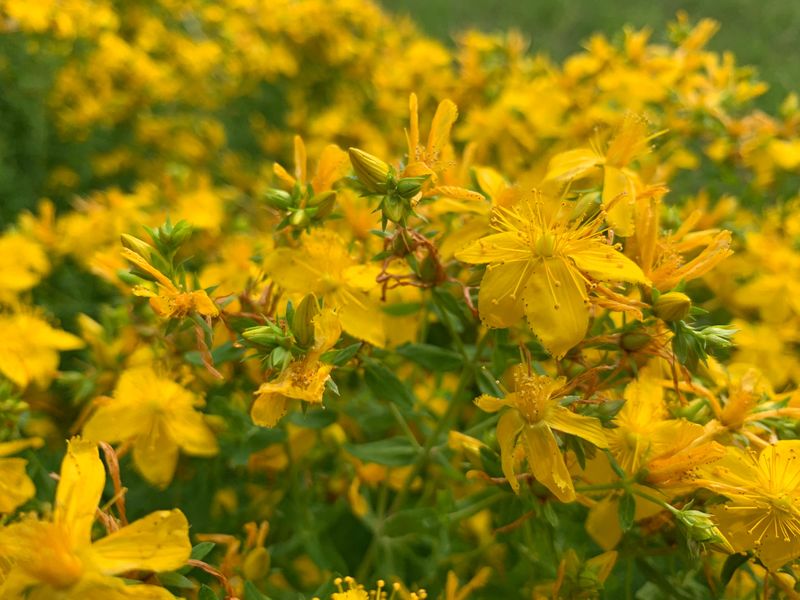
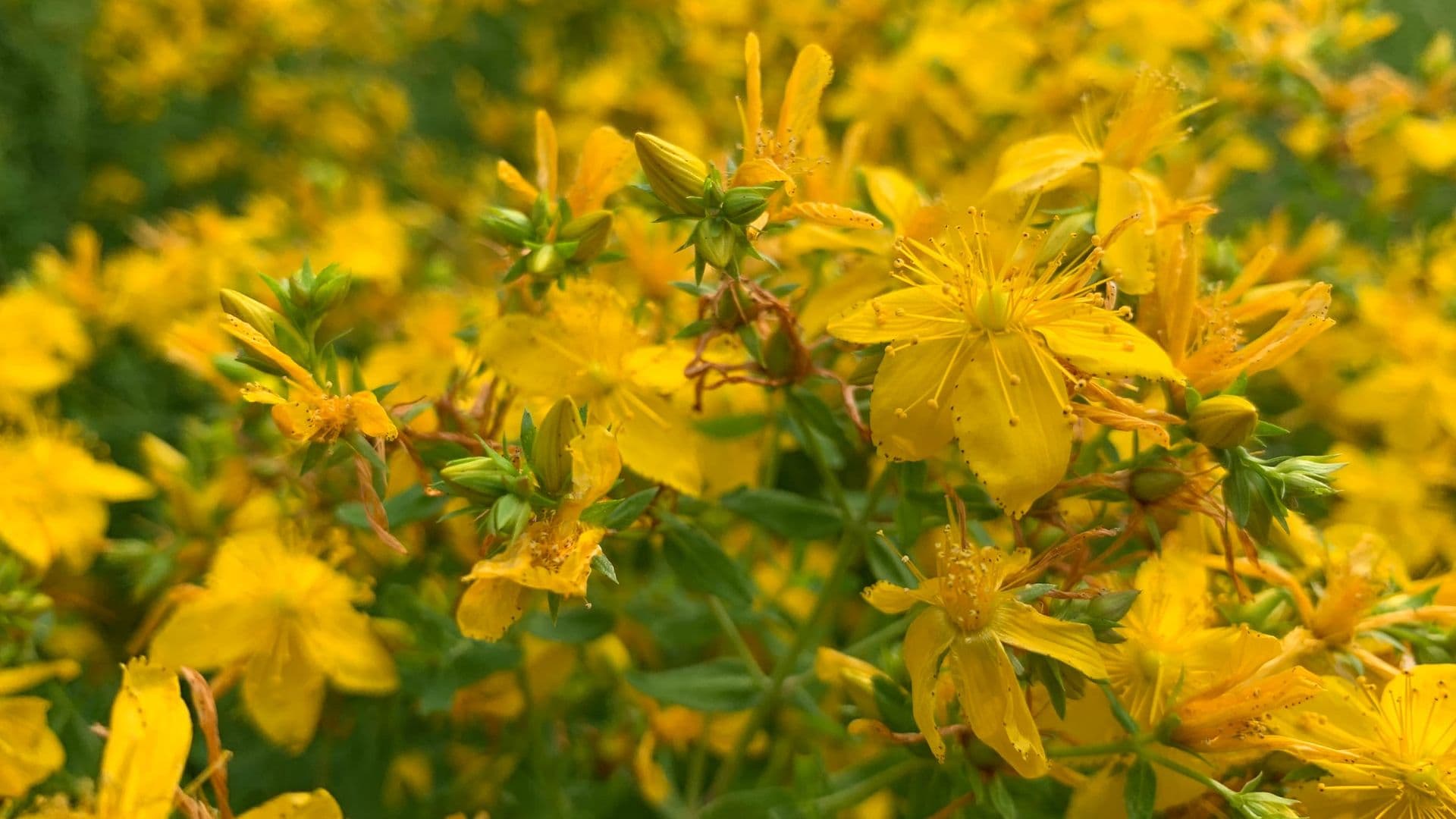
The opposite, oval-elliptical to elongated linear leaves are densely dotted with pale, translucent oil glands — this has earned the species the epithet “perforatum”. In June, usually around St John's Day, the plant blooms with yellow, five-part flowers arranged in false umbels. The petals display dark glandular spots; each petal has a flat and a convex side, giving the flower the shape of a pinwheel. Numerous stamens stand at the centre in several bundles, radiating outward like rays and bestowing the flower with a sun-like appearance. When the flower is crushed, the contained hypericin leaves a blood-red stain.
Essence of the plant
Light assimilation, strength to counter nervous sensitivity, stability
St John’s Wort has the strongest relationship to light of all medicinal plants. The plant, which blooms around the time of the summer solstice, promotes the absorption and storage of light and its conversion into nerve energy. Light is an essential energy source for the nerves, the interface between body and soul.
Those who cannot draw sufficiently from this source because their ability to absorb light is weakened due to constitutional or situational reasons, or because the availability of light is reduced by persistently dull weather or prolonged stays in artificially lit rooms, become gloomy and depressed. St John’s Wort then has an uplifting effect. St John’s Wort is also indicated for injuries of both body and soul.
Depressions resulting from physical and psychological injuries and hurts, or cuts and stab wounds with nerve damage, are treated very successfully. The nervous system is stabilised. Observe dosage!
Hypericum perforatum
St John’s Wort
From shape to healing power
This video is provided by YouTube and requires your consent.
St John's Wort is a midsummer plant, it blooms around St John's Day (24th June). It belongs to the family of rock-rose plants and grows at pathsides, in clearings, on fallow meadows as well as in gravel pits. Its striking features are the stability of the stem, the light affinity of the flowers, the "perforated" oval leaves and the red dye contained within it.
St John's Wort flowers appear like left- and right-turning windmills. The family name rock-rose already says a lot. Even in the snow of winter, the rigid, withered stems of St John's Wort stand at the roadside and awaken wistful memories of past summer days. The stem is firm and two-edged (a rarity in the plant kingdom) and grows upright with a slight spiral twist and a gentle upward curve (like a spine) towards the light.
The numerous, crosswise opposite, more or less straight lateral branches are slanted upwards, so that two side branches each form an equilateral triangle standing on its point and open upwards. Like a figure whose arms are extended upwards in a receiving manner. Letting this framework of stem and side branches affect our mind, we have an image of stability and balance. A scale that is in equilibrium.
Precisely because in the framework we find a high order, but no perfect straightness and symmetry. Everything is slightly twisted and bent and thus expresses the principle of stability in nature. Why? There is a wise plan in nature, and everything is arranged according to a certain order.
In living nature we find symmetries, numerical regularities, cycles, harmonic patterns, rhythms, yet they are never mathematically perfect. Mathematical perfection belongs to the realm of the mineral, of crystals. In the realm of the living, absolute order means rigidity and death. It is known, for example, that patients shortly before a heart attack have a heart rhythm whose phases are absolutely synchronous.
A rigid system can no longer be regulated and collapses at the slightest disturbance. The golden-yellow petals of St John's Wort are radially symmetrical, spread out in one plane like little sun discs. From above, it is noticeable how they are twisted from the inside outwards.
The St John's Wort flowers have a distinct direction of rotation and resemble small windmills. In which direction does the rotation run? We find approximately equal numbers of right- and left-turning flowers – and this is an exception in the plant kingdom. There are other flowers that also have a direction of rotation, but it always goes in the same direction.
Oleander flowers, for example, always rotate to the right and evergreen flowers always to the left. If there is a balance between right and left, this indicates a "standing in the middle". At St John's time, the transition takes place from the constructive part of the year (symbolised by right rotation) to the destructive part of the year (symbolised by left rotation). St John's Wort blooms not by chance in the middle of the year (other plants also bloom at this time) but because this belongs to its innermost essence.
Then, when the days are longest, the light forces most intense, Hypericum unfolds its sun-like flowers and seems to absorb their light energy like wheels (compare chakras). The abundance of light forces is impressively expressed in the very numerous stamens and anthers, which radiate like sparks from the flower disc. The speckled translucent leaves give the name. The harmoniously shaped, oval and stalkless leaves appear as if punctured with holes (hence the name addition perforatum).
In reality, these are the translucent cells of secretory cavities. There is a direct connection here between the signature and the specific effect of St John's Wort in puncture wounds. This also has a psychological dimension, as St John's Wort can also be used for emotional injuries. When crushing the flowers or buds between the fingers, a blood-red dye emerges.
This substance group is the hypericins. The Hypericum mother tincture or the St John's oil are also deep red. Red is the colour of activity and willpower. Through this abundant dye, St John's Wort expresses that the assimilated light forces can be transformed into willpower.
Organic and Demeter cultivation
St John's wort is native to Europe, Western Asia and North Africa and grows on poor meadows, waysides, forest clearings and clear-cuts. It prefers dry, sunny locations on calcareous to slightly acidic soils.
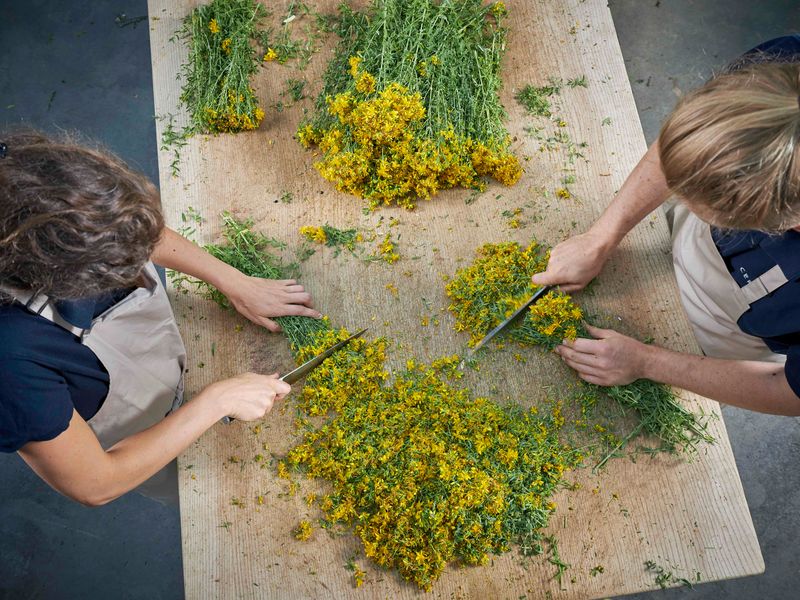
Ceres harvests St John's wort in June — at this time approximately two thirds of the plants are in bud and one third have open flowers. This harvest time is crucial for the hypericin and hyperforin content. The harvest is carried out exclusively by hand, in the morning, from organic or Demeter cultivation in Switzerland.
Traditional Use
St. John's Wort, Hypericum perforatum L., has been one of the best-known medicinal plants from antiquity through the Middle Ages and up to the present day. Among the numerous naturopathic areas of application, those referring to the nerves, psyche, digestion and wound healing have today become predominant. Mental exhaustion, digestive disorders, injuries of the peripheral and central nervous systems, and mood disorders are among the current areas of application. These are based on the homeopathic medicinal product profile and/or long-standing traditional herbal medicine use. Furthermore, St. John's Wort is used to support wound healing in cases of inflammation and burns of the skin. For external use, oily preparations from St. John's Wort (red oil) are common. St. John's Wort is today one of the best-researched medicinal plants, with proven clinical efficacy and good tolerability.
Sources
1. Hänsel, R. & Steinegger, E. Hänsel / Sticher Pharmakognosie Phytopharmazie. (Wissenschaftliche Verlagsgesellschaft GmbH, Stuttgart, Deutschland, 2015).
2. Madaus, G. MADAUS LEHRBUCH DER BIOLOGISCHEN HEILMITTEL BAND 1-11. (mediamed Verlag, Ravensburg, 1990).
3. Committee on Herbal Medicinal Products (HMPC). Assessment report on Hypericum perforatum. EMA/HMPC/101303/2008 (2009).
4. BGA/BfArM (Kommission E). Hyperici herba (Johanniskraut). Bundesanzeiger 228, (1984).
5. BGA/BfArM (Kommission D). Hypericum perforatum (Hypericum). Bundesanzeiger 190 a, (1985).
6. Linde, K., Berner, M. M. & Kriston, L. St John’s wort for major depression (Review). Cochrane Database Syst. Rev. (2008). doi:10.1002/14651858. CD000448.pub3
7. Kalbermatten, R. & Kalbermatten, H. Pflanzliche Urtinkturen. (AT Verlag, Aarau, Schweiz, 2018).
8. Kalbermatten, R. Wesen und Signatur der Heilpflanzen. (AT Verlag, Aarau, Schweiz, 2016).
Balance between Build-up and Breakdown
R. & H. Kalbermatten — «Psyche des Menschen und Signatur der Heilpflanzen»
Ceres mortar process — gentle, cold and complete.
Freshly harvested, hand-picked, ground at room temperature and aged for years. No heating, no pressure - the plant's full vitality is preserved.