Valerian
Valeriana officinalis
Grounding, discharge, Mother Earth
Botany
Valeriana officinalis L., the common valerian, is a biennial to perennial herb from the valerian family (Valerianaceae). The underground parts consist of a cylindrical rhizome with numerous roots up to 30 cm long and many fine lateral roots — a dense root network that anchors the plant very firmly. The underground parts emit a characteristic scent, which is especially liked by cats.
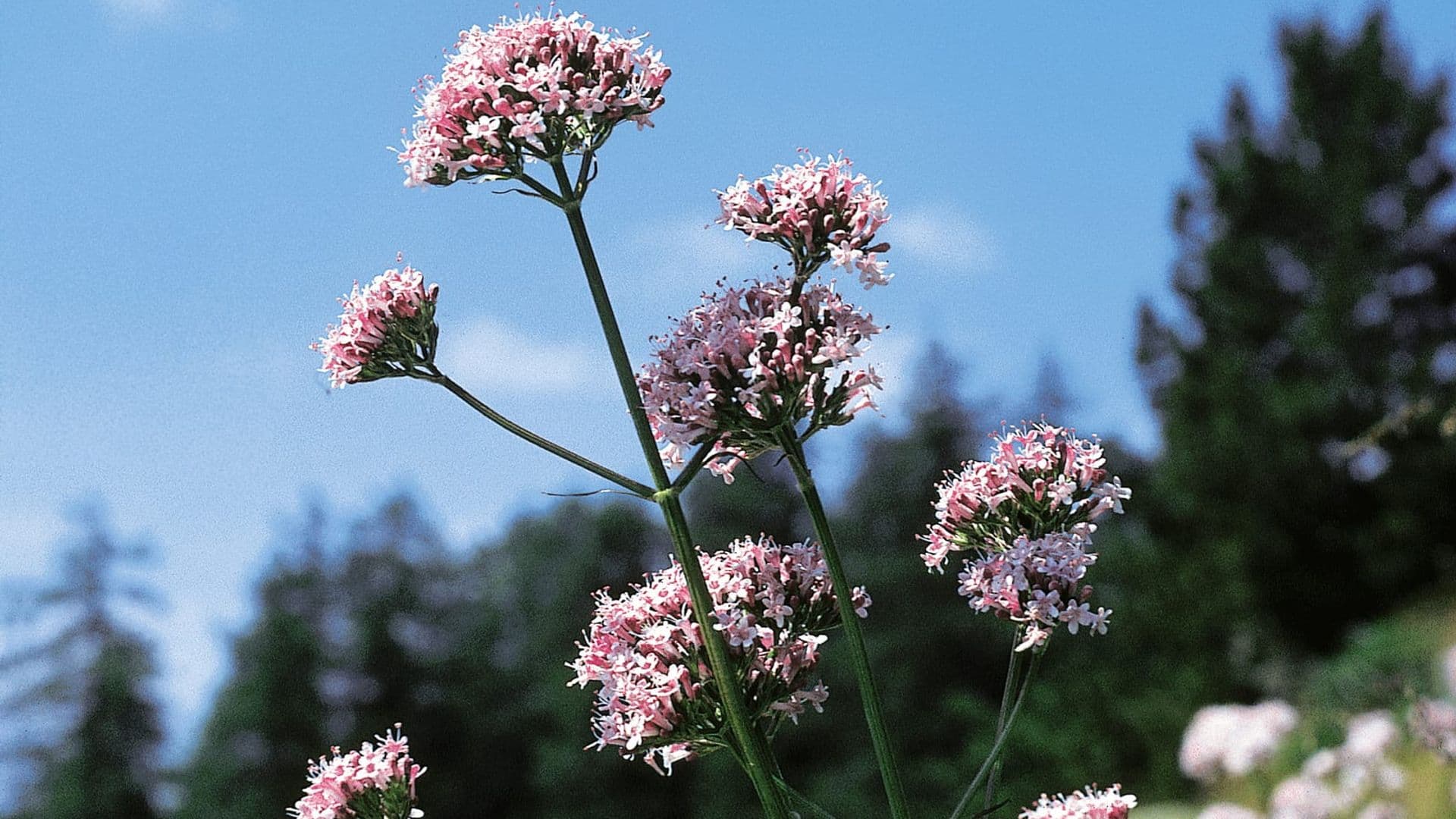
In the first year, the plant produces only bushy, odd-pinnate basal leaves. Usually, the stems emerge only in the second year, growing upright up to 150 cm tall. The opposite leaves are odd-pinnate, with elliptical to narrowly lanceolate leaflets. From May to August, typically pale pink, sometimes white flowers appear in umbrella-shaped compound umbels with a pleasant scent.
Essence of the plant
Grounding, discharge, Mother Earth
Valerian has a mediating and deductive essence. It channels an excess of nerve-sensory energy away and grounds it, neutralising an excess of «nerve electricity». In doing so, Valerian helps the human type who is at risk of losing their footing and drifting, who exhibits excessive mental activity with a tendency to flighty thoughts and develops hypersensitivity of the senses.
Such people often have something transparent, ethereal about them. Through its grounding effect, Valerian restores the balance between thinking and sensory activity and metabolic activity. The difficulty in using Valerian lies in its marked polarity and its applicability for opposing character traits.
Fundamentally, thinking and feeling must be in the correct proportion to each other, in balance. If feelings dominate, no structured and rational thoughts can be formed. However, if thinking lacks the warmth of the heart, isolated products of thought arise that are not in harmony with the laws of life in nature and the cosmos, leading to destructive outcomes.
This destruction can be directed inward or outward. Inwardly, excessive depletion of life forces, hypersensitivity, nervousness, and over-sensitivity develop.
This corresponds to the above-described human type. The destructive consequences of isolated thinking outwardly are increasingly emerging in our time. If feelings dominate, thinking is weakened; it runs uncontrolled, indulgent, and cannot be purposefully managed.
Feelings prevail, not worries. Thoughts become independent but are emotional thoughts revolving around hurt feelings, praise and blame, acceptance or rejection. Events are repeatedly contemplated, actually felt through.
Thoughts cannot be limited, ended, or structured. An inner restlessness spreads due to feelings. Due to its mediating and grounding nature, Valerian can also act in a balancing and sedative way in such situations.
Valeriana officinalis
Valerian
From shape to healing power
The flowers of valerian develop an enchanting scent. It is hardly bearable to stay for long in a flowering valerian field, with its tension charged through scent, colour, and form. The inflorescence is a false umbel, meaning it resembles the inflorescence of umbellifers externally, although it is not as orderly structured as the latter. The flower colour ranges from white to pink and appears translucent and slightly phosphorescent.
After the valerian has finished blooming, feathered hairs arise from the calyx during the fruiting period, which shape the plant’s appearance with their delicate grey patterns. The leaves are pinnate and have deeply slanted serrated leaflets. The entire leaf conveys a tension-charged, torn impression, like a high-frequency, irregular vibration pattern. Although the plant is decorative, hardly anyone would put it in a vase in the living room; not only because of the scent.
When picked, the stem usually breaks off. This is peculiar because valerian is quite steadfast at its growing site. But obviously, it loses its stability when it is cut. Such a root is firmly anchored in the ground.
With the root, the character of the plant changes profoundly. At a thumb-thick rhizome hang countless long, thin roots. Dug up and washed, the root looks like a long, whitish beard with almost straight hairs. The root impresses through its abundance and simple, parallel structure; root nestles against root. The entire rootstock – although composed of a multitude of individual roots – is calm and harmonious.
One can easily imagine how firmly valerian is anchored in the soil with its many individual roots and how it is able to ground and conduct away the energies that find expression in the fineness and tension of the above-ground plant parts. Opinions differ greatly on the smell of valerian roots, which is even more intense than the flower scent but of a completely different character: many dislike it, yet this does not change the fact that it usually acts very supportive and calming. A treatise on valerian would be incomplete without mentioning cats’ great fondness for this plant. A valerian plant placed outside quickly becomes a popular attraction for all cats in the neighbourhood.
They wallow in it, try to penetrate it with their heads, lie on their backs on it, and eat from it (although they generally abhor all vegetarian food). Unlike dogs, cats are known to seek out precisely those places charged with disruptive fields and detrimental to humans. We can also observe that cats like to lie in bed with the ill. Evidently, these cherished pets have an important function for humans.
They can assimilate and conduct away energies that cause illness in humans. Thus, we have an energetic symbiosis between humans and cats, wherein both benefit from one another. These observations confirm the previous findings that valerian roots have an energetically conducting and decomposing character. They draw off an excess of energy needed for sensory and cognitive activity and thus bring about a soothing of the unstoppable, exhausting nervous activity.
Organic cultivation
Valerian is native to Europe and parts of Asia. In Switzerland, it grows in damp locations, along streams, and in riparian forests from lowlands to subalpine areas.
Ceres harvests valerian from organic cultivation in Switzerland. After harvesting, the roots are carefully washed, sorted, and then dried.
Traditional Use
Already Hippocrates, the holy Hildegard, and also Paracelsus knew the valerian root as a valuable medicinal product, and even today valerian is one of the best-known medicinal plants and the subject of intensive research activity. On the medicinal product market, numerous preparations, tinctures, and herbal teas can be found. The main therapeutic areas of application for valerian are states of restlessness and nervous sleep disorders. Patients taking valerian report improved sleep quality and improvement in sleep-related disorders such as restless leg syndrome or anxiety, as well as improvements in states of restlessness, including in the area of attention deficit/hyperactivity disorder (ADHD). In homeopathy, sciatica pain – dull, throbbing, and radiating nerve pain that can start suddenly and may also manifest as increased muscle sensitivity, muscle cramps, and numbness – is also among the areas of application. Soothing and sleep-promoting plants – valerian, oat, hops, St John's wort, lavender, lemon balm, passionflower, and others – can help to reduce or even replace the use of synthetic and often not equally well-tolerated sleep medicinal products (antihistamines, benzodiazepines).
Sources
1. Hänsel, R. & Steinegger, E. Hänsel / Sticher Pharmakognosie Phytopharmazie. (Wissenschaftliche Verlagsgesellschaft GmbH, Stuttgart, Deutschland, 2015).
2. Madaus, G. MADAUS LEHRBUCH DER BIOLOGISCHEN HEILMITTEL BAND 1-11. (mediamed Verlag, Ravensburg, 1990).
3. Bent, A., Moore, D., Patterson, M. & Mehling, W. Valerian for sleep : A systematic Review. Am J Med 119, 1005–1012 (2015).
4. Shinjyo, N., Waddell, G. & Green, J. Valerian Root in Treating Sleep Problems and Associated Disorders—A Systematic Review and Meta-Analysis. J. Evidence-Based Integr. Med. 25, 1–31 (2020).
5. Anheyer, D., Lauche, R., Schumann, D., Dobos, G. & Cramer, H. Herbal medicines in children with attention deficit hyperactivity disorder (ADHD): A systematic review. Complement. Ther. Med. 30, 14–23 (2017).
6. Committee on Herbal Medicinal Products (HMPC). European Union herbal monograph on Valeriana officinalis L., radix. Eur. Med. Agency EMA/ HMPC/1, (2016).
7. BGA/BfArM (Kommission D). Valeriana officinalis (Valeriana). Bundesanzeiger 190a, (1985).
8. BGA/BfArM (Kommission E). Valerianae radix (Baldrianwurzel). Bundesanzeiger 90, (1985).
9. Kalbermatten, R. & Kalbermatten, H. Pflanzliche Urtinkturen. (AT Verlag, Aarau, Schweiz, 2018).
10. Kalbermatten, R. Wesen und Signatur der Heilpflanzen. (AT Verlag, Aarau, Schweiz, 2016).
Ceres mortar process — gentle, cold and complete.
Freshly harvested, hand-picked, ground at room temperature and aged for years. No heating, no pressure - the plant's full vitality is preserved.