Oats
Avena sativa
Ability to cope with stress, absorbing shocks, stabilising rhythms
Botany
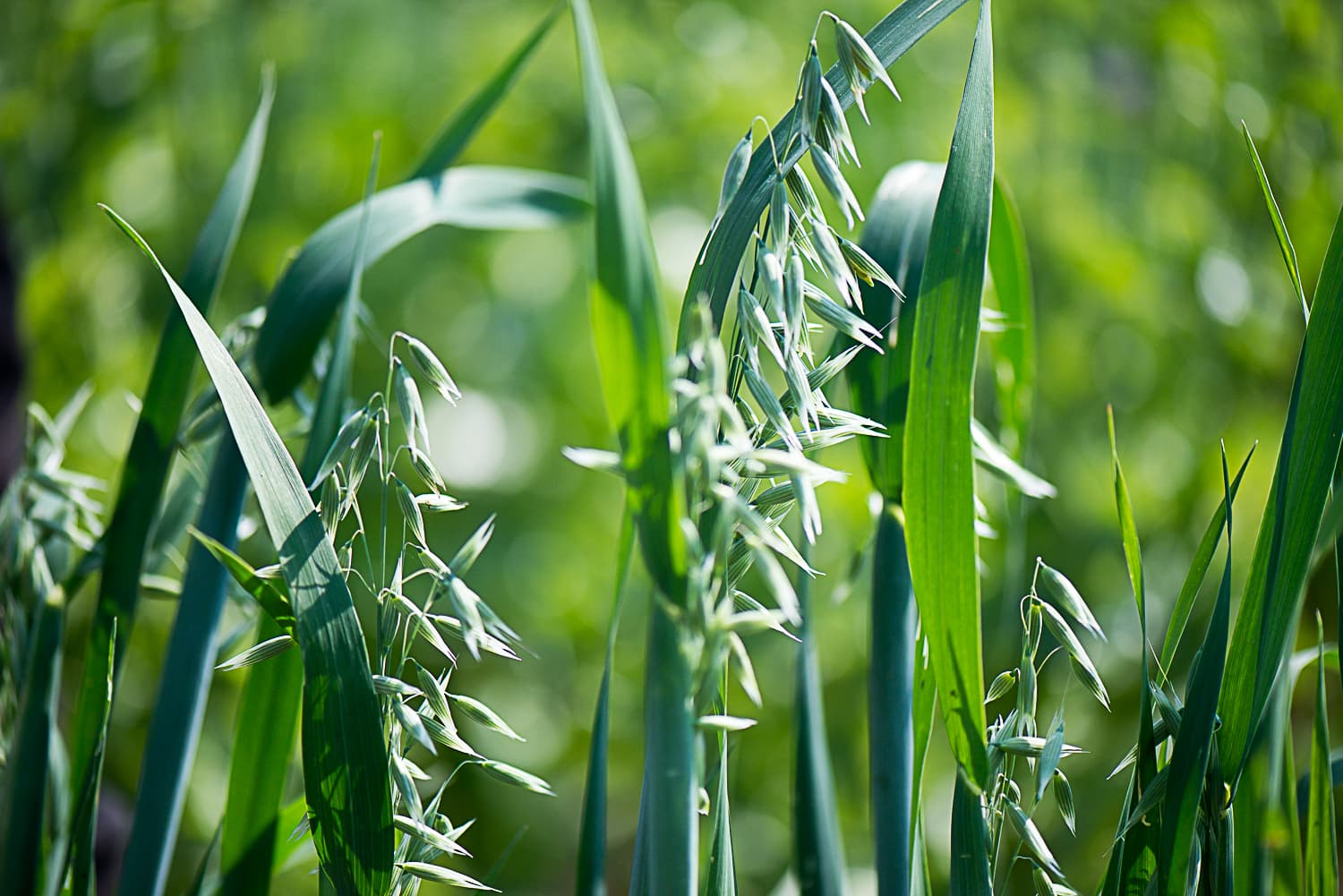
Oats (Avena sativa L.) belong to the family of sweet grasses (Poaceae). They grow to a height of 60 to 150 cm. Their linear-lanceolate leaves clasp the stem and can reach up to 450 mm in length; they have a finely rough texture. Oats flower from June to August. Unlike other cereal species, their inflorescence is arranged differently: the flowers are borne in a panicle with freely movable, hanging flowers — other cereals have flowers closely attached to the stem in the form of an ear. The original area of origin is not precisely known; today, oats are cultivated worldwide. They also grow in poor conditions, intensely root the soil, and serve as erosion protection.
Essence of the plant
Ability to cope with stress, absorbing shocks, stabilising rhythms
It is the essence of oat to absorb the energy of influences that can throw us off our rhythm. These occur when we feel pressured or chased, whether due to difficult tasks, working under time pressure, distress, or shocks. Oat absorbs shocks and thereby promotes resilience.
It supports the emotional coping with external pressure as well as severe physical exhaustion. Our time is characterised by rapidly changing demands, instructions, regulations and work processes, and not least by chasing images. Just as something is created, a restructuring or an "improvement" is already being sought.
For many people, this is the reality of their working day. In states of nervous exhaustion and loss of rhythm due to the aforementioned situations or after debilitating illnesses, oat has a nerve-strengthening effect and is able to re-establish the disturbed sleep-wake rhythm.
Emotional energy – the prerequisite for resilience in difficult situations – flows to us only when different activities are carried out in a certain rhythm. Tasks must be able to be completed within an appropriate period (neither too short nor too long). In this respect, humans are bound into natural rhythms.
If the rhythm of daily human life no longer resonates with this, a great loss of energy, fragmentation, and stress ensue. Figuratively speaking, humans are driven through life. Sensitive people react particularly strongly to these situations.
Through its stabilising nature, oat is able on one hand to increase resilience and on the other to sharpen awareness that people often subject themselves unnecessarily to agitation and hecticness by allowing themselves to be drawn into the whirlpool of diverse offers. With a conscious choice and possibly also a renunciation, an unshakeable calm can once again take root in the human essence. This also applies to any addiction issues that may be present.
Avena sativa
Oats
From shape to healing power
Oats, belonging to the family of grasses (Graminaceae), are an extremely mobile and elastic plant; anything rigid is alien to them. Comparing them with other cereals such as barley, rye, or wheat, a significant difference in the arrangement of the flowers or fruits is noticeable. The fruits of these cereal types sit close to the stem and form a compact ear.
How differently oats behave. Its flowers, and later its fruits, hang on fine, delicate stalks. When an oat field sways in the wind, the fine flowers begin to softly vibrate in a second, additional oscillation, playing a silent melody. This is possible because the flowers are not rigidly attached to the stem but are movably suspended on very thin flower stalks.
How must a building be constructed to absorb strong vibrations, for example a structure in an earthquake-prone area? Rigid constructions are of little use here; what is required is a design that can absorb the energy of shocks. The inflorescence of oats is constructed in exactly this way. The essence of its construction is load-bearing from above, like a suspension bridge.
By comparison, the other cereals would then be bridges supported on solid pillars. To inner perception, oats reveal themselves as a force line system of a load-bearing arch construction with stretched strings – like a harp. Oats – harp, the similarity of the terms is surely no coincidence. The plant oats and the instrument harp share a kinship of essence.
Demeter cultivation
Ceres uses fresh oat greens from Demeter cultivation in Switzerland. The plant is harvested at the beginning of the flowering period — a narrow harvest window that requires great care.
Traditional Use
The word "Avena" is said to originate from the Sanskrit "avasa", meaning "food". For this reason, it is not surprising that oat was one of the most important cereals, especially in the Middle Ages. Its great significance as a health-promoting food was also emphasised by Paracelsus and the herbalist pastor Sebastian Kneipp. Furthermore, medicinal preparations made from oat are regarded as a balancing tonic for the nervous system. Therefore, invigorating oat can be used across all age groups to address the consequences of stress and overwork. The strengthening properties of this cereal also explain its use during convalescence after exhausting and debilitating illnesses. Traditionally, oat is also applied for mood swings and mild sleep disturbances. Literature also contains references to the potential use of oat as a supportive aid for people with addiction problems.
Sources
1. Committee on Herbal Medicinal Products (HMPC). Assessment report on Avena sativa L., herba and Avena sativa L., fructus. (2008).
2. Madaus, G. MADAUS LEHRBUCH DER BIOLOGISCHEN HEILMITTEL BAND 1-11. (mediamed Verlag, Ravensburg, 1990).
3. Committee on Herbal Medicinal Products (HMPC). Community Herbal Monograph on Avena sativa L
4. BGA/BfArM (Kommission D). Avena sativa. Bundesanzeiger 190a, (1985).
5. Vonarburg, B. Homöothanik - Arzneipflanzen der Homöopathie. (Haug Verlag, 2009).
6. Kalbermatten, R. & Kalbermatten, H. Pflanzliche Urtinkturen. (AT Verlag, Aarau, Schweiz, 2014).
7. Kalbermatten, R. Wesen und Signatur der Heilpflanzen. (AT Verlag, Aarau, Schweiz, 2016).
Ceres mortar process — gentle, cold and complete.
Freshly harvested, hand-picked, ground at room temperature and aged for years. No heating, no pressure - the plant's full vitality is preserved.