Passionflower
Passiflora incarnata
Calmness of the heart, finding oneself, one’s own inner sound
Botany
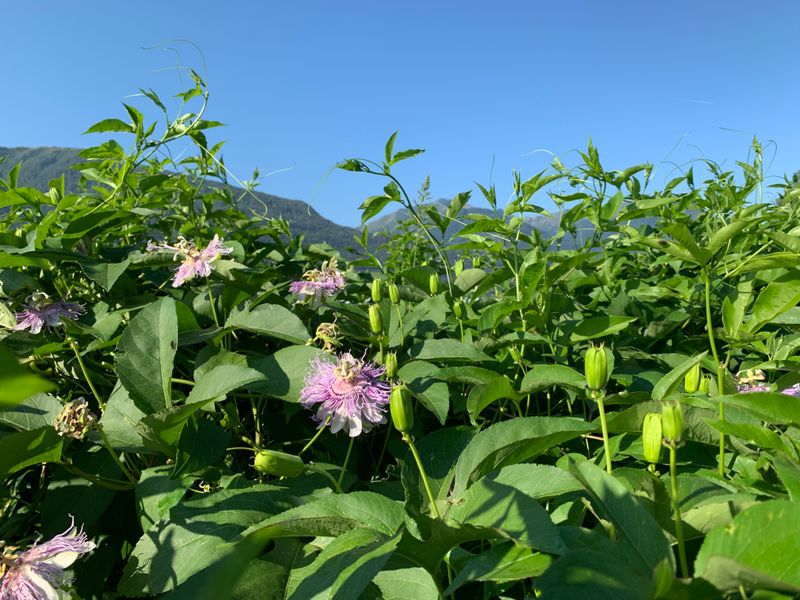
Passiflora incarnata L., the passionflower, belongs to the family Passifloraceae. Most species are found in the tropics and subtropics of South and Central America and are sensitive to frost; Passiflora incarnata shows a certain frost hardiness. The perennial climbing plant forms 5-10 m long, thin but surprisingly sturdy stems with alternate, deeply three-lobed leaves. Long simple tendrils coil corkscrew-like, enabling the plant to pull itself upwards. In warm weather, the plant can emit a cabbage-like smell.
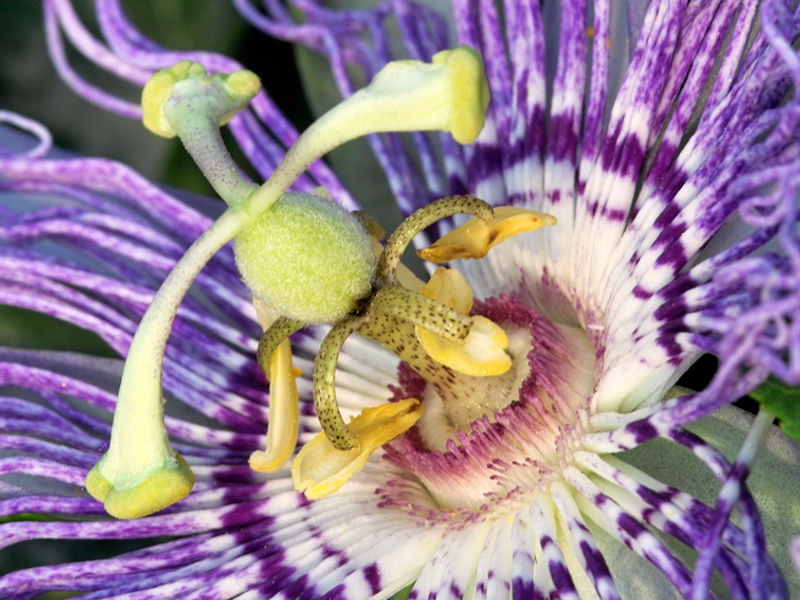
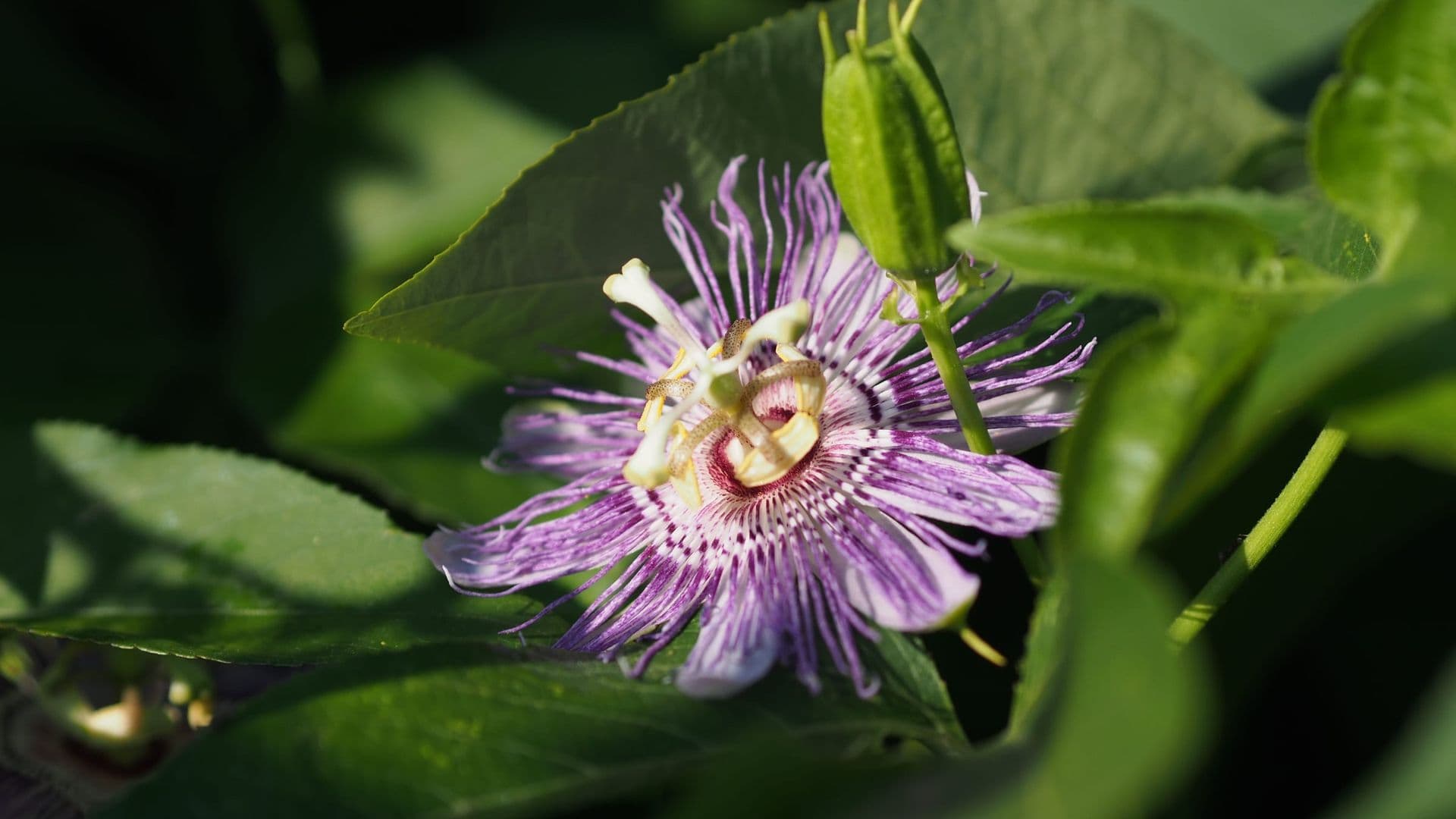
From July to September, the plant blooms with its typical, expressive flowers, which seem composed of concentric circles. Striking are the 10 radially outward-pointing petals, which look white from above — from below they are divided into 5 white crown and 5 green calyx petals. A filamentous corona is banded violet-white. The 5 stamens spread widely around the central column, at the centre of the ovary with three prominent styles. Each flower blooms for only about a day. The fruits are not as tasty as those of the related passionfruit species.
Essence of the plant
Calmness of the heart, finding oneself, one’s own inner sound
The passionflower has a special relationship with the heart. It symbolises heart calmness, the state of «being in harmony with oneself». Passiflora grants heart calmness and supports the process of letting go.
A person moves from life cycle to life cycle, experiencing metamorphoses along the way. Again and again, they must say goodbye to something that has served its purpose. Thus the old can transform into the new, the higher.
If they can embrace the farewell, it inspires them. Holding on and rebellion weigh them down and become sources of restlessness and worry. Adults often resist letting go of what is familiar and dear to them.
Children, on the other hand, react immediately, unconsciously, and physically to change. The consequences can be restlessness, hyperactivity, or alternatively passivity and withdrawal. Those who rarely find moments to cultivate inner peace, or who are pulled in different directions at the same time, risk losing themselves.
The essence of Passiflora has the property of helping people find their way back to themselves from the periphery of life. It aids in hearing one’s own inner tone again, acts as a releasing, balancing force, and grants calmness. In this way, a person is strengthened in their centre.
Passiflora incarnata
Passionflower
From shape to healing power
The various Passiflora species are perennial climbing plants originating from the warm regions of the American continent and have been cultivated in our area for centuries as ornamental plants due to their beautiful flowers. The flowers are stunning, yet very fleeting, blooming for only one day. What makes these flowers special are the many concentric circles we can observe in their structure. When viewing the flower from above and starting our examination at the periphery, we recognise a corona of 10 petals, whose tips form an outermost circle.
Looking more closely at the flower from below, we see that the 10 ‘petals’ consist of 5 green sepals underneath and 5 coloured petals between them. The plant has created a unification, a harmonisation on the upper side, through this colour adjustment of sepals and petals. Perhaps the most striking feature of the flower is the corona inside the aforementioned petals, consisting of countless fine filaments. These filaments are arranged in 4 concentric circles around the floral axis.
The outermost circle consists of very long filaments lying on the petals, radiating outwards like fine lines. They are coloured in alternating dark purple, white and light purple, creating several concentric colour rings. Following these are the inner circles of filaments, which consist of very short, bristly stubs. Further inwards lies the circle of 5 stamens fused into a tube at the base, and in the centre at the core, we see the ovary with the 3 prominent styles.
Altogether, we count 10 concentric circles in one flower. It is evident that forces relating to the essence of the circle were at work in the design of this flower. An intuitive observation of the essence of this plant confirms this insight: We see a restless water surface with rippling waves. Then the chaotic waves begin to settle, and large concentric wave rings form, moving towards their centre and becoming smaller.
This centre is our heart. In the middle, all the wave rings gradually dissolve. What remains is a calm, mirror-smooth water surface. The image just described from inner perception is exactly the opposite of the image created when a stone is thrown several times in succession into still water at the same spot.
Each stone throw causes a new wave ring; overall, there are several rings spreading centrifugally from the shared centre, eventually disturbing the entire water surface. The passion flower has a central relation to the ‘psychic’ heart as well as the physical organ of the beating heart. Through its essence, it is able to still the restlessness of the heart. An essential medicinal product made from Passiflora is primarily used for states of restlessness resulting from heart matters, anxiety, worrisome thoughts, fears of loss, and so forth.
Organic cultivation
Passiflora incarnata is native to southeastern North America (Virginia to Florida) and has been introduced in Europe and other temperate regions as a garden and medicinal plant. It prefers sunny to semi-shaded, well-drained soils.
Ceres uses passionflower herb from organic cultivation. The plant is grown in Ticino, where the climate and location are optimal for Passiflora. The blooming herb is harvested in summer.
Traditional Use
The passionflower, Passiflora incarnata L., originates from the southern part of North America. It is used alone or in combination in finished medicinal products. Passionflower is known for its calming, anxiolytic effect. Consequently, it can be used for nervous insomnia, sleep disorders, states of restlessness and tension, stress, mood swings, cramps, and neurasthenia. Functional and nervous heart complaints, referred to in naturopathy as cardiac neurosis, are a special area of application for passionflower.
Sources
1. Hänsel, R. & Steinegger, E. Hänsel / Sticher Pharmakognosie Phytopharmazie. (Wissenschaftliche Verlagsgesellschaft GmbH, Stuttgart, Deutschland, 2015).
2. BGA/BfArM (Kommission E). Passiflorae herba (Passionsblumenkraut). Bundesanzeiger 223, (1985).
3. Madaus, G. MADAUS LEHRBUCH DER BIOLOGISCHEN HEILMITTEL BAND 1-11. (mediamed Verlag, Ravensburg, 1990).
4. BGA/BfArM (Kommission D). Passiflora incarnata. Bundesanzeiger 190 a, (1985).
5. Committee on Herbal Medicinal Products (HMPC). Assessment report on Passiflora incarnata L ., herba. EMA/HMPC/669738/2013 (2014).
6. Kalbermatten, R. & Kalbermatten, H. Pflanzliche Urtinkturen. (AT Verlag, Aarau, Schweiz, 2014).
7. Kalbermatten, R. Wesen und Signatur der Heilpflanzen. (AT Verlag, Aarau, Schweiz, 2016).
Life Cycles
R. & H. Kalbermatten — «Psyche des Menschen und Signatur der Heilpflanzen»
Ceres mortar process — gentle, cold and complete.
Freshly harvested, hand-picked, ground at room temperature and aged for years. No heating, no pressure - the plant's full vitality is preserved.