Hop
Humulus lupulus
Retreat, merriment, lightness
Botany
Humulus lupulus L., common hop, is a perennial climbing plant from the family of Cannabaceae. During the growing season, the hop can develop shoots up to 8 m or even longer, which are covered with climbing hairs and twine clockwise around their support. Most other climbers twine counterclockwise. The long shoots regenerate every year from the underground rhizome and can grow up to 10 cm per day; cultivated hop can live up to 50 years.
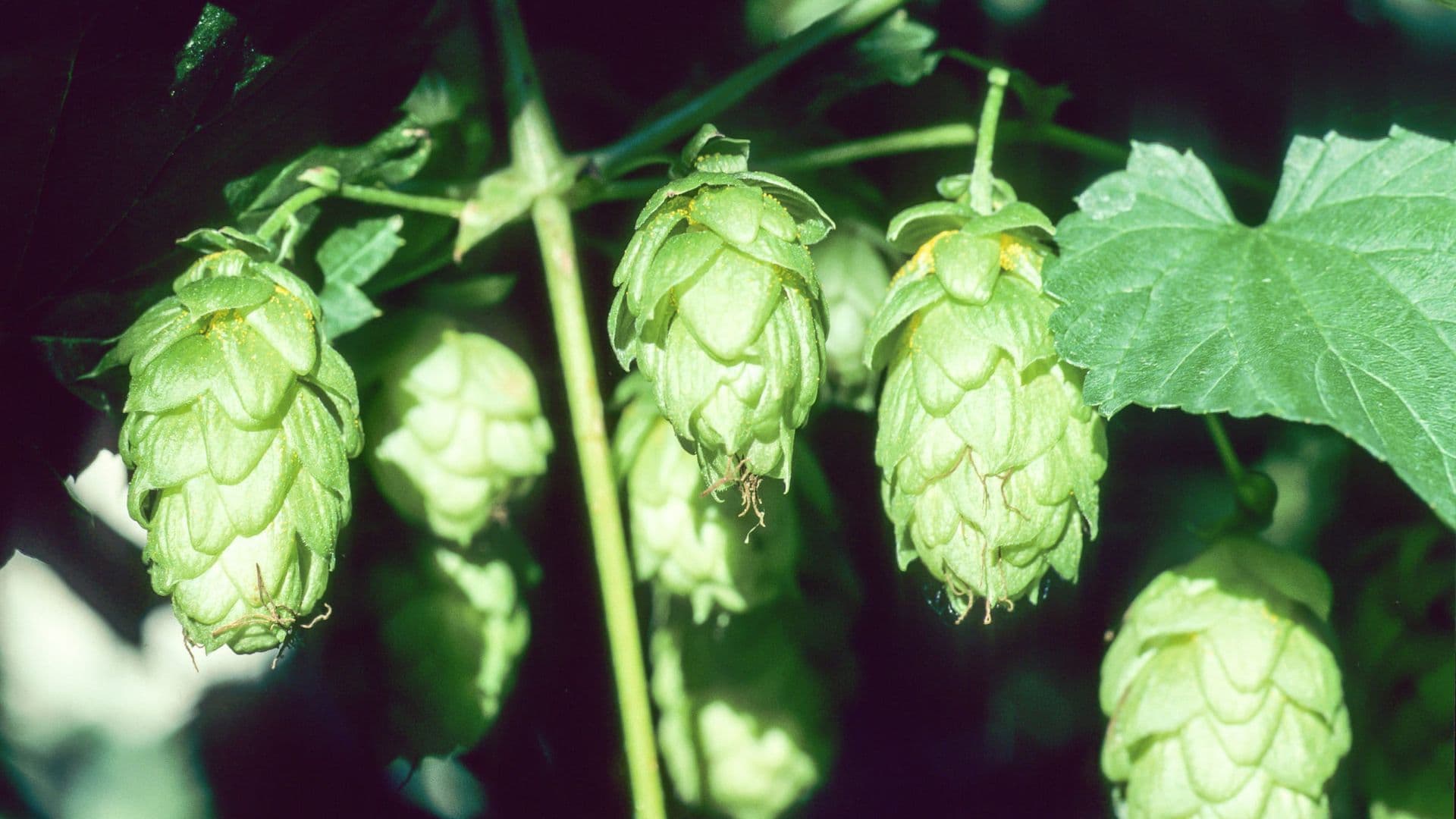
The large, dark green, rough-hairy leaves are opposite and are 3- to 5-lobed. Hop flowers from July onwards. There are male and female plants. The male flowers are inconspicuous in loose panicles; the female flowers are found in the familiar ovate, spike-like catkins — the hop cones. The bracts on these overlap like roof shingles and form the 2 to 5 cm long inflorescence. The inner sides of the bracts are covered with small, shiny, pale yellow glandular scales that contain the bitter hop resin. The female flower clusters emit an intensely spicy aroma and taste strongly bitter.
Essence of the plant
Retreat, merriment, lightness
Hops is a plant that symbolises withdrawal. Its essence is not focused on implementing ideas or applying energies. In rest and seclusion or within the protected circle of like-minded individuals, thoughts wander without becoming concretely creative.
Having given your energy and commitment at work or in life, the reversal now follows in the evening of your leisure or life. After a completed day’s work, one may now relax. Energies can flow in the opposite direction; one is set to receive and regenerate.
Hop cones are soft and light. The essence of hops shields itself from disturbing influences that pull one back into everyday life; either through retreat into “monastic” solitude or the enclosure of a circle of friends. Thoughts rise in circles, moving away from duties and responsibilities, wishing to detach from reality.
Distance can dissolve tensions and restlessness; the spirit becomes cheerful and light. The essence of hops helps people who are more attached to the metabolic pole and tend towards a certain earthly heaviness, who are drowsy during the day and awake at night. With the intake of hops, they lose the heaviness and drowsiness and experience liberating calm at night.
Preparations of hops can also work inversely. People whose sphere of action has diminished due to age-related ailments or illness often have difficulty adjusting. They feel internally still very active but are limited externally by their disability or age. This creates tension and restlessness.
Similarly, many young people feel full of energy and desire to become active; however, their potential for activity has not yet formed or is insufficiently defined. They must learn to subordinate themselves and thus experience limitation; tension arises. In many life situations, the right time must be awaited in order to act.
There is the risk of losing patience, becoming pessimistic or aggressive. Through a change, one has outgrown a life area, standing “on the empty platform on the right track” and waiting. The new situation is announced but not yet concretely present.
Now it is important to wait and endure the tension. The vital force of hops helps to dissolve the mentioned tensions by directing the creative potential into the right channels. Through this relaxation, the proper sleep rhythm can be restored.
Humulus lupulus
Hop
From shape to healing power
Hop is a climbing plant that grows up to 8 m high. The plant is dioecious, meaning there are female and male plants. Cultivated hop is exclusively female, as the female fruiting bodies, the hop cones, just before ripening, are used for the production of beer or medicinal products. The yellowish green, hanging fruiting body is ovoid and externally consists of 1 to 2 cm long bracts (scales) that overlap like roof tiles.
The inner sides of the bracts are covered with small, shiny, pale yellow glandular scales. These glands contain the active ingredients: the bitter-tasting resin and the aromatic-smelling essential oil. When hop arrives at our laboratory for processing in late summer, it is always a very joyful occasion, as good mood and lightheartedness are included in the delivery. A sack of fresh hop spreads a wonderful, sweetish scent that immediately affects the psyche; cheerfulness and lightness spread, and people feel connected to one another.
The scales of the armour of our personality, with which we often shield ourselves internally, fall away of their own accord and allow us to approach each other. The roof-tile-like structure of the hop cones is also something special and mysterious. Fresh hop cones are fine, light, soft yet compact; they promise a rich inner life, abundance and fertility. One wants to touch the cones, open them, tear them apart – they are simply incredibly attractive.
The hop cones are female and ovoid. They promise life and fertility. Life is present in union, in symbiosis; it is many small scales that form the egg. The hop cones evoke thoughts of childhood, of carefreeness and the symbiosis with the mother.
Hop is a nourishing plant; it nourishes not with calories but with life forces. In beer, the calories come from the malt and alcohol, making this popular drink a wonderful means to evoke feelings of security and fusion, as were naturally experienced in childhood. Since the gently soothing and nourishing effect of hop takes place on the psychological level and partially satisfies the desire for fusion there, the sexual drive – the desire for physical fusion – is diminished. Hop has long been a remedy for dampening an excessive male sexual drive.
It is also worth mentioning that the hop plant twists to the right. This is rare, as most climbing plants twist to the left. The direction of spiral forms has an important energetic significance; left-turning spirals lead forces out of matter, while right-turning coils accompany the materialisation of forces. Thus, through right-turning, the maternal, symbiotic nature of hop is further emphasised.
Demeter cultivation
Hop is native to Europe and Western Asia and grows in floodplains, hedgerows, and forest edges as a climbing plant on nutrient-rich, moist soils. As a cultivated plant, it is grown worldwide for brewing beer.
Ceres uses hop cones from Demeter cultivation. The ripe cones are harvested in late summer, when the content of bitter substances and hop oil is at its highest.
Traditional Use
The use of bitter hops as an additive in beverages – whether to improve shelf life or for flavouring – has been known since at least the Middle Ages. Besides beer production, the character of the essential oil and the bitter substances of the respective hop variety can also unfold their effect medicinally in aromatherapy. Typical for hops is the calming and sleep-promoting effect. The anxiolytic and the anaphrodisiac effects described in traditional herbal medicine have also been investigated. Therefore, the areas of application for hops include restlessness, nervousness, anxiety disorders, and sleep disturbances. As an Amarum aromaticum, hops can also prove useful through its bitter effect, for example in dyspeptic complaints.
Sources
1. Hänsel, R. & Steinegger, E. Hänsel / Sticher Pharmakognosie Phytopharmazie. (Wissenschaftliche Verlagsgesellschaft GmbH, Stuttgart, Deutschland, 2015).
2. Madaus, G. MADAUS LEHRBUCH DER BIOLOGISCHEN HEILMITTEL BAND 1-11. (mediamed Verlag, Ravensburg, 1990).
3. Committee on Herbal Medicinal Products (HMPC). Assessment Report on Humulus Lupulus L., Flos. EMA/HMPC/418902/2005 (2014).
4. European Scientific Cooperative On Phytotherapy (ESCOP). ESCOP Monographs. (Georg Thieme Verlag, Rüdigerstrasse 14, D-70469 Stuttgart, Germany and Thieme New York, 333 Seventh Avenue, New York NY 10001, USA, 2003).
5. Saller, R., Melzer, J., Uehleke, B. & Rostock, M. Phytotherapeutische Bittermittel. Schweizerische Zeitschrift fur GanzheitsMedizin 21, 200–205 (2009).
6. BGA/BfArM (Kommission D). Humulus lupulus (Lupulus). Bundesanzeiger 172 a, (1988).
7. Zanoli, P. et al. Experimental evidence of the anaphrodisiac activity of Humulus lupulus L. in naïve male rats. J. Ethnopharmacol. 125, 36–40 (2009).
8. Kalbermatten, R. & Kalbermatten, H. Pflanzliche Urtinkturen. (AT Verlag, Aarau, Schweiz, 2018).
9. Kalbermatten, R. Wesen und Signatur der Heilpflanzen. (AT Verlag, Aarau, Schweiz, 2016).
Ceres mortar process — gentle, cold and complete.
Freshly harvested, hand-picked, ground at room temperature and aged for years. No heating, no pressure - the plant's full vitality is preserved.