A race against time: Why the processing of fresh plants determines the quality of the tincture
Ceres Redaktion · 10 April 2026
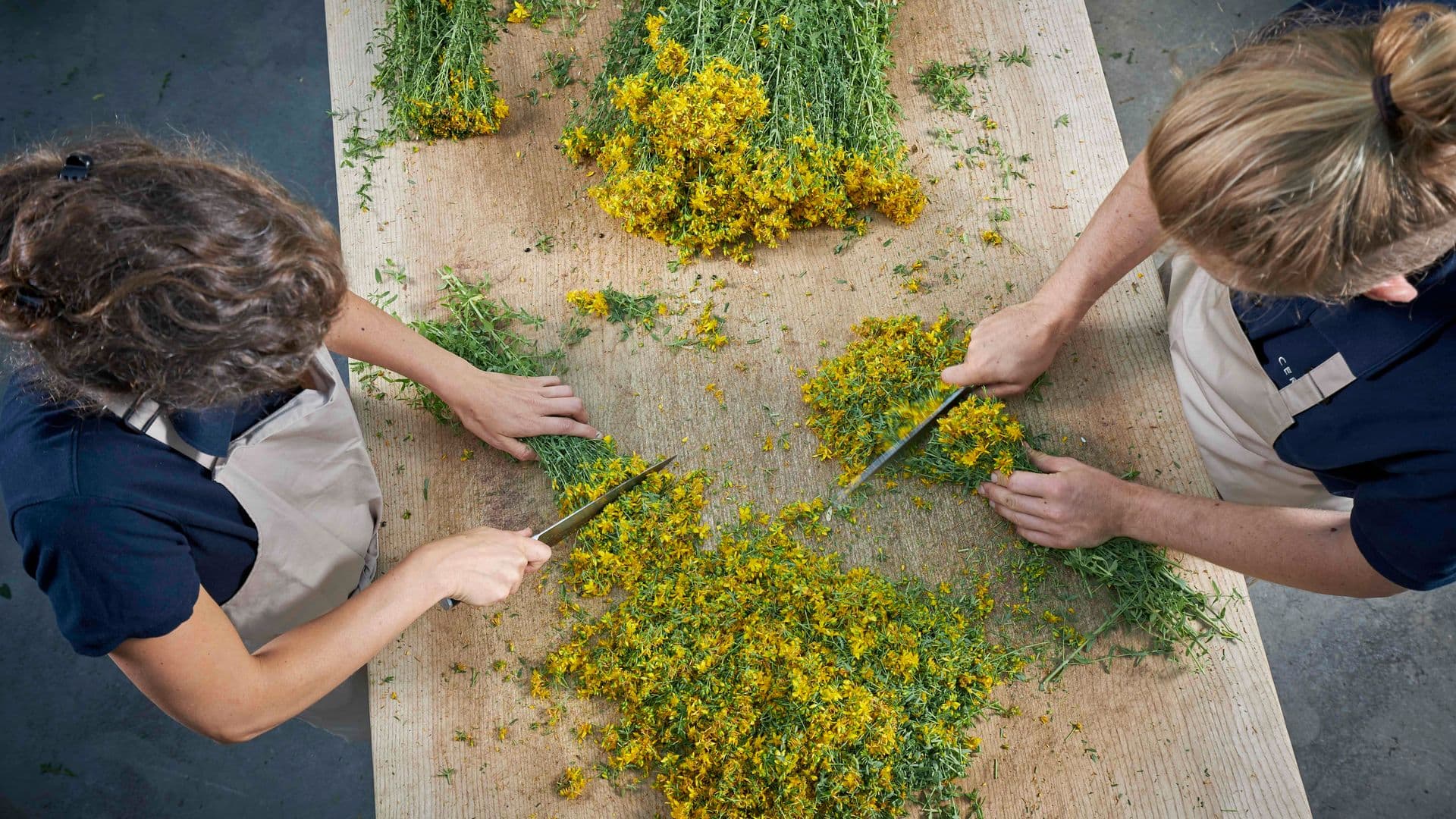
What happens during the first minutes of producing homeopathic mother tinctures — and why 30 minutes of air exposure can reduce antioxidant activity by up to 44%.
Source of study: Barmaverain D, Hasler S, Kalbermatten C, Plath M, Kalbermatten R. Processes, 2022
Study design: Analytical laboratory investigation (oxidative stress test, UV-Vis spectroscopy, antioxidant assay)
Published: July 2022 · DOI: 10.3390/pr10071335 · Editor's Choice
Note: Laboratory analytical study — no clinical conclusions
Cutting open a fresh plant initiates a process that cannot be stopped: enzymes that were previously separated by the intact cell structure come into contact with phenolic compounds — and with oxygen. What follows is an oxidation cascade long known in the food and cosmetics industries: the browning of avocados, the colour loss in freshly pressed juice, the deterioration of sensitive raw materials.
This connection has hardly been scientifically investigated so far in the production of herbal medicinal products. A study by the Ceres research team focused precisely on this — demonstrating that minutes can determine the quality of a homeopathic mother tincture.
What was investigated
The research team of Didier Barmaverain, Samuel Hasler, Christoph Kalbermatten, Matthias Plath and Roger Kalbermatten investigated four medicinal plants used in the production of mother tinctures: Echinacea purpurea (purple coneflower), Mentha piperita (peppermint), Ginkgo biloba and Hypericum perforatum (St John’s wort).
For the experiment, freshly harvested plants were ground under cryogenic conditions — i.e. at extremely low temperatures with liquid nitrogen — in order to inhibit enzymatic processes and obtain a reference extract as free from oxidation as possible. Subsequently, the same plant material was extracted after 30 minutes of air exposure to simulate the effect of oxidation.
The resulting tinctures were analysed by UV-Vis spectroscopy, an antioxidant assay (potassium permanganate) and an enzymatic tyrosinase test. Additionally, several commercially available mother tinctures from different manufacturers — including Ceres Heilmittel AG — were examined for their oxidation state.
What happens when a plant waits too long
The result of the oxidative stress test is clear: just 30 minutes of air exposure after grinding leads to a measurable decrease in antioxidant activity in all four tested plants. For Echinacea, this reduction is 44 %, for peppermint 43 %. St John’s wort loses 20 % of its antioxidant activity, while Ginkgo proves comparatively robust with 10 %.
30 minutes of air exposure after grinding can reduce the antioxidant activity of a fresh plant tincture by up to 44 % — depending on the plant species.
The cause lies in the enzyme group of polyphenol oxidases (also called tyrosinases): as soon as the cell integrity is destroyed by cutting or grinding, these enzymes from the plastids come into contact with the plant’s phenolic compounds. In the presence of oxygen, they catalyse the oxidation of hydroxyl groups — those structures primarily responsible for the antioxidant effect of phenolic compounds. The oxidised products further react to brown polymers (melanins), which do not dissolve in hydroalcoholic solvents and are therefore absent in the finished tincture.
The UV-Vis spectrum offers a surprisingly simple diagnostic window: oxidation manifests as a characteristic flattening of the typical absorption curve — a ratio of maximum to minimum that measurably decreases and correlates linearly with the decline in antioxidant activity. The authors suggest that this method could be used as a rapid quality control in routine analytics.
Comparison of commercial batches
In addition to the controlled laboratory experiment, commercially available mother tinctures from five different manufacturers were analysed. The results are heterogeneous: the tested batches differ considerably in their antioxidant activity — some foreign batches even showed activity below that of the artificially oxidised laboratory extract.
The tinctures from Ceres Heilmittel AG demonstrated higher antioxidant activity across the analysed plant species — with the exception of Ginkgo, where all manufacturers showed comparable values — as well as a less pronounced flattening of the UV absorption curve.
The authors attribute this to specific features of the Ceres manufacturing process: fresh plants are ground in a specially developed, closed mill that minimises air contact and in which alcohol is already present during the milling process — a condition that inhibits enzymatic oxidation. However, the authors state that a final attribution of cause is not possible due to the many variable factors between different manufacturers.
The results suggest that not only the initial quality of the plant but also every single second of the processing affects the quality of the finished mother tincture.
Context and limitations of the study
The study is an analytical laboratory investigation — not a clinical study. It makes no claims regarding whether higher antioxidant activity in vitro translates to clinically relevant differences. The authors explicitly point out that the clinical significance of these analytical differences was not known at the time of publication.
The study was conducted and funded by the research and development team of Ceres Heilmittel AG. Christoph Kalbermatten is CEO, Roger Kalbermatten founder of Ceres Heilmittel AG. These disclosures are fully transparent within the publication. The study was published in the professional journal Processes (MDPI), selected as Editor's Choice, and underwent a regular peer-review process.
Nevertheless, what the study achieves is significant: it names oxidation during fresh plant processing as a relevant quality variable in the production of homeopathic mother tinctures — for the first time in the scientific literature — and proposes UV-Vis spectroscopy as a simple, practical method for its quantification.
Original publication
Barmaverain D, Hasler S, Kalbermatten C, Plath M, Kalbermatten R. Oxidation during Fresh Plant Processing: A Race against Time. Processes. 2022;10(7):1335. DOI: 10.3390/pr10071335
Open Access: mdpi.com/2227-9717/10/7/1335
Continue on Ceres channels
These links open the respective platforms directly. They are intended as a supplement to the article, not as a native in-page interaction.