Coneflower
Echinacea purpurea
Shielding, containment, protective skin
Botany
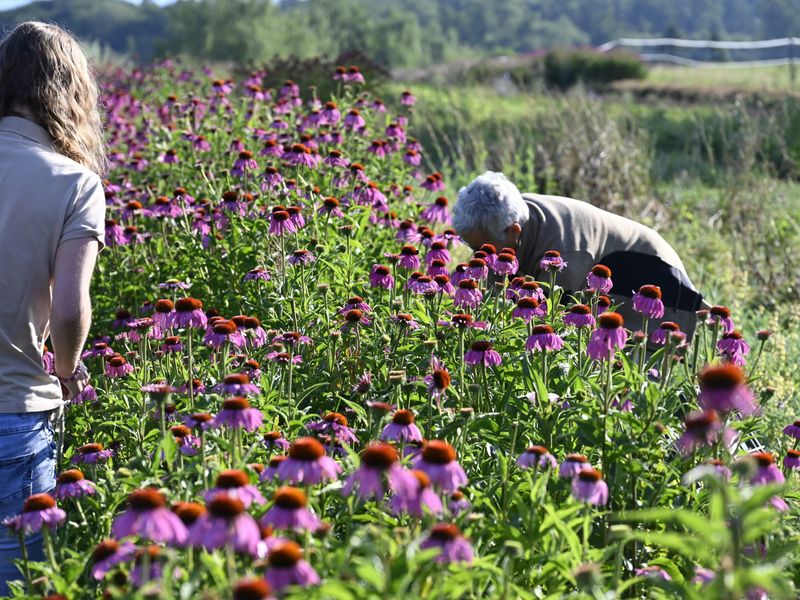
Echinacea purpurea (L.) MOENCH, the red coneflower, is a perennial herb from North America and reaches an impressive height of up to 1.80 m. The leaves are broadly ovate at the base and broadly lanceolate at the tip. Stems and leaves are covered with bristly hairs — a rough, scratching appearance that seems to contrast with the expressive flower heads.
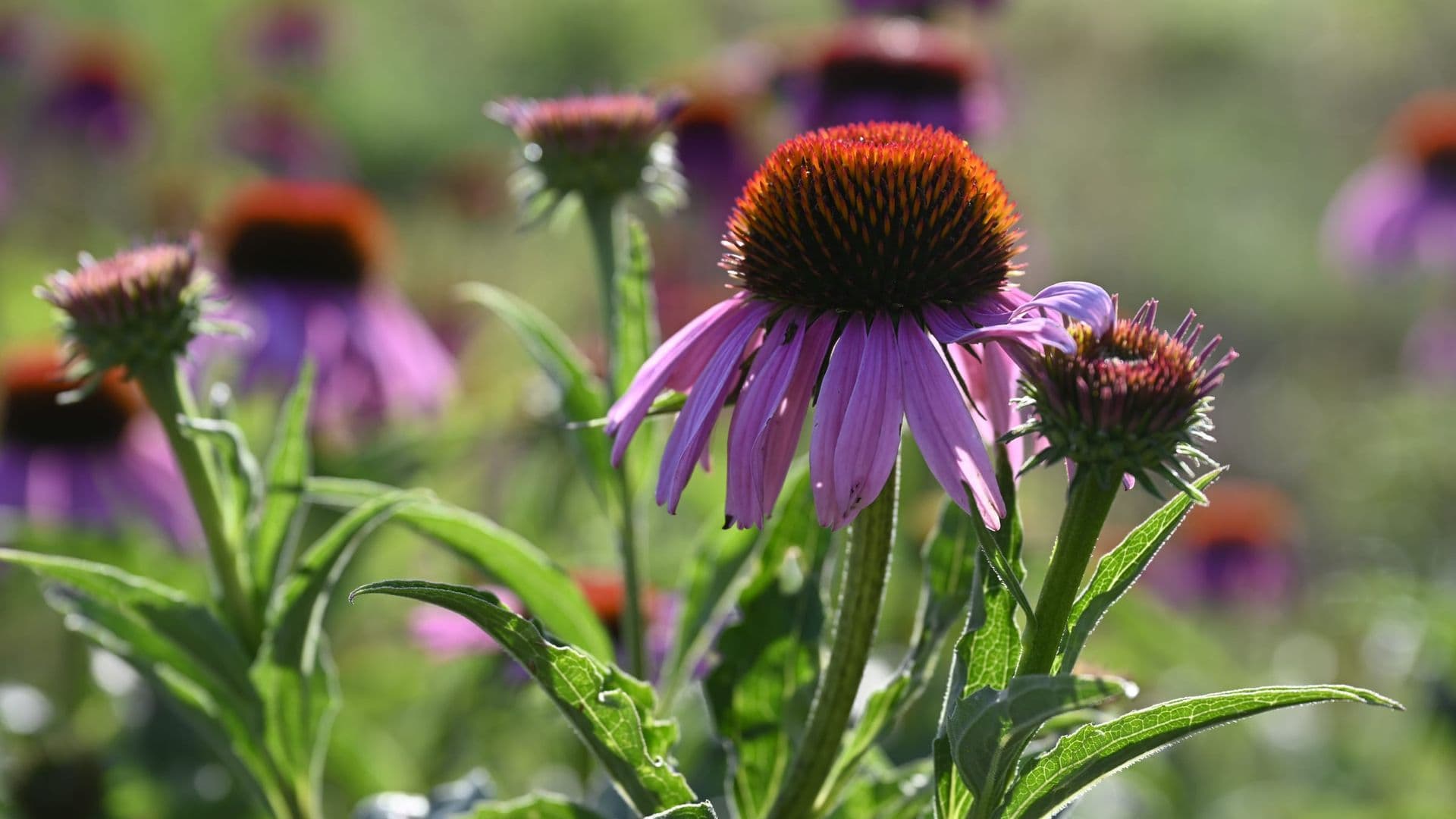
From June to August, the pink to purple flower heads appear at the stem tips. At first, the still green ray florets stand upright; over time they gain their colour and bend downwards by 180 degrees. The tubular florets in the centre of the flower head are accompanied by hard chaff leaves, which feel like a hedgehog — hence the name “hedgehog’s head”; also, Echinacea derives from the Greek echinos (hedgehog). During the flowering phase, the central part bulges conically, giving the flower head its characteristic shape.
Essence of the plant
Shielding, containment, protective skin
It is the nature of Echinacea to shield us with a protective layer, a shield against which potential triggers of conflict rebound. Infectious diseases arise from the interplay of three factors: pathogens, physical defence (immune system, milieu) and psychological defence. Since pathogens are always present without necessarily causing an infection, the key lies with the defence.
The importance of the immune system and the milieu is generally well known, yet the psychological influence on the immune system is not to be underestimated. A weakened defence is often triggered by a conflict situation. It is important here to distinguish between weakening and strengthening conflicts.
Conflicts are strengthening and need to be lived through when they contribute to a process of awareness, for example regarding setting boundaries against psychological exploitation. They are weakening if they arise from a trivial cause, if one rages, becomes angry or quarrels over matters that either do not concern one at all or are so insignificant that they would be better ignored. Conflicts often flare up in stressful situations (overload with work and problems, lack of sleep, damp and cold weather). Then even the slightest cause can become a trigger.
Therefore, it is necessary to develop a psychological immunity to the many small imperfections of life, to ignore them. The essence power of Echinacea supports us in this. Echinacea almost literally envelops us with a protective layer that shields us and holds together what would otherwise fall apart into separation and thus lead to conflict.
Echinacea purpurea
Coneflower
From shape to healing power
The flower head of the coneflower has a characteristically upward-curved receptacle towards the centre. Additionally, the brown, domed inner part of the head is covered with spiny bristles, giving it the shape and character of a hedgehog in a defensive posture. This feature gave the genus its botanical name Echinacea (from the Greek echinos, hedgehog). The English name “Cone Flower” also refers to the conical curved flower base, as does the German name “Echinacea”, which describes the sombrero-like shape of the flower in the mid-flowering stage (see below).
The marginal purple ray florets perform a movement of around 180 degrees during flower development. At the beginning, when the flower is just opening, they stand straight upwards, are still narrowly rolled up, short and barely coloured. At this point, the flower base is not yet curved. Later, the ray florets tilt to the horizontal and reach their full size and colour.
At this stage, the flower base begins to curve upwards and becomes increasingly spiky. The flower head now has the shape of a sombrero. Subsequently, the ray florets begin to tilt downwards until they stand vertically down at full bloom, shielding both the calyx and the flower stalk. Notably, the calyx hides from view through this gesture of the ray florets.
The calyx is the outermost part or the skin of a flower, as it forms the bud's outer covering at the beginning of the flower's existence. With its radiant, purple petals and the highly domed centre of the flower heads, the coneflower is a beautiful, proud flower. Its scent is light, unobtrusive and at the same time very nuanced and noble. Far from any heaviness or sweetness, this fragrance conveys something elevated.
The character of aloofness sensed from sight and smell is confirmed upon touch. Besides the hedgehog-like bristliness of the flower base, it is expressed in the rough, scratchy surface of the leaves and stem, which one does not notice on the well-formed plant but is clearly evident when touched. This feature also underlines a plant personality focused on shielding and allowing nothing to come near. Chewing a piece of root, a flower or a leaf of the plant, or taking a few drops of the mother tincture directly onto the tongue, reveals a somewhat sharp taste that leaves a furry feeling and a slight anaesthetising effect.
This is the effect of the isobutylamides, a class of ingredients found in all parts of the plant in varying concentrations. Shielding and aloofness are the essential qualities that we can recognise in the shaping forces of the plant. Such a character is easily associated with the well-known strengthening of the body’s own defence system by Echinacea extracts. The immune system is the biological defence mechanism that prevents pathogens from entering, multiplying, and spreading.
The functional principle of the immune system is thus shielding, so that pathogenic microorganisms do not get too close. Leaves and stems are rough-haired. In this area, Echinacea also unfolds its psychological effect. Its essence, focused on shielding and aloofness, supports our soul in letting trivial attacks and irritations flow away or bounce off us.
The essence of Echinacea grants us a kind of protective skin, a suit of armour or knight’s armour, thereby keeping all arrows away from us. It helps us overlook, not perceive, or disregard the unimportant. Just as the immune system constantly keeps countless pathogens at bay without our conscious involvement, the resourceful psyche ignores emotional irritations that are not relevant to us at the moment. In this, Echinacea provides support.
Demeter cultivation
Echinacea purpurea originates from eastern North America (Great Plains to the east coast) and is now cultivated worldwide in temperate climate zones. In Europe, it is a popular garden plant.
Ceres uses fresh Echinacea purpurea from Demeter cultivation in Switzerland. The flowering herb is harvested at full bloom in mid-summer.
Traditional Use
The medicinal plant Echinacea purpurea (L.) MOENCH, originally native to America, has a long tradition in Native American medicine. It is therefore no surprise that the use of Echinacea preparations quickly secured a firm place among homeopathic doctors in the USA. The Echinacea plant eventually made its way to Europe, where it is now cultivated in large quantities for the manufacture of medicinal products. The dosage forms are varied and range from fresh plant juices and extracts to phytotherapeutic and homeopathic tinctures. Respiratory infections are the main area of application for Echinacea. In herbal medicine, Echinacea is used for the prevention and treatment of colds. This is considered a well-documented, established area of application. Homeopathically, Echinacea purpurea (L.) MOENCH is also used as a complementary treatment for severe and febrile infections.
Sources
1. Hänsel, R., Keller, K., Rimpler, H. & Schneider, G. Hagers Handbuch der pharmazeutischen Praxis Band 5 Drogen E-O. (Springer-Verlag Berlin Heidelberg 1993, 1993).
2. Hänsel, R. & Steinegger, E. Hänsel / Sticher Pharmakognosie Phytopharmazie. (Wissenschaftliche Verlagsgesellschaft GmbH, Stuttgart, Deutschland, 2015).
3. Madaus, G. MADAUS LEHRBUCH DER BIOLOGISCHEN HEILMITTEL BAND 1-11. (mediamed Verlag, Ravensburg, 1990).
4. Committee on Herbal Medicinal Products (HMPC). Assessment report on Echinacea purpurea (L.) Moench., radix. EMA/HMPC/424584 (2016).
5. BGA/BfArM (Kommission D). Echinacea purpurea. Bundesanzeiger 213, (1989).
6. BGA/BfArM (Kommission E). Echinaceae purpureae herba (Purpursonnenhutkraut). Bundesanzeiger 43, (1989).
7. Kalbermatten, R. & Kalbermatten, H. Pflanzliche Urtinkturen. (AT Verlag, Aarau, Schweiz, 2014).
8. Kalbermatten, R. Wesen und Signatur der Heilpflanzen. (AT Verlag, Aarau, Schweiz, 2016).
The unconscious defensive capacity
R. & H. Kalbermatten — «Psyche des Menschen und Signatur der Heilpflanzen»
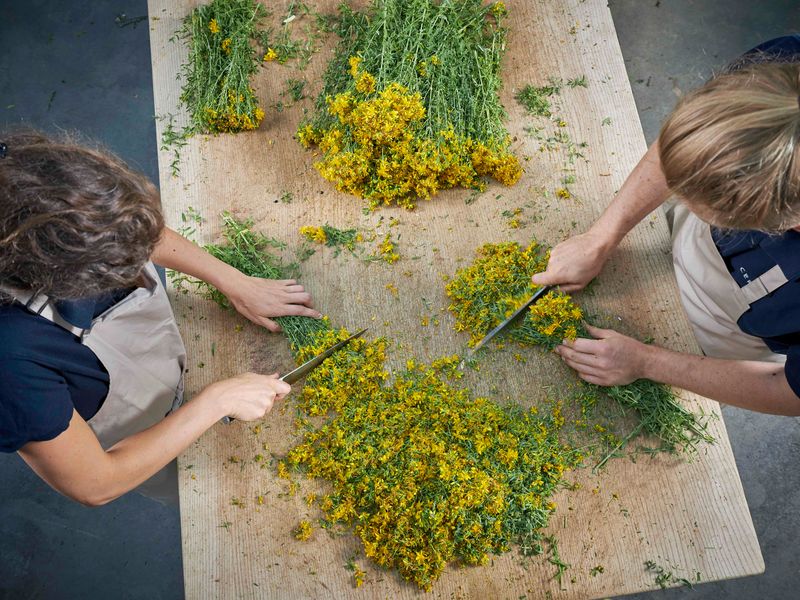
Ceres mortar process — gentle, cold and complete.
Freshly harvested, hand-picked, ground at room temperature and aged for years. No heating, no pressure - the plant's full vitality is preserved.