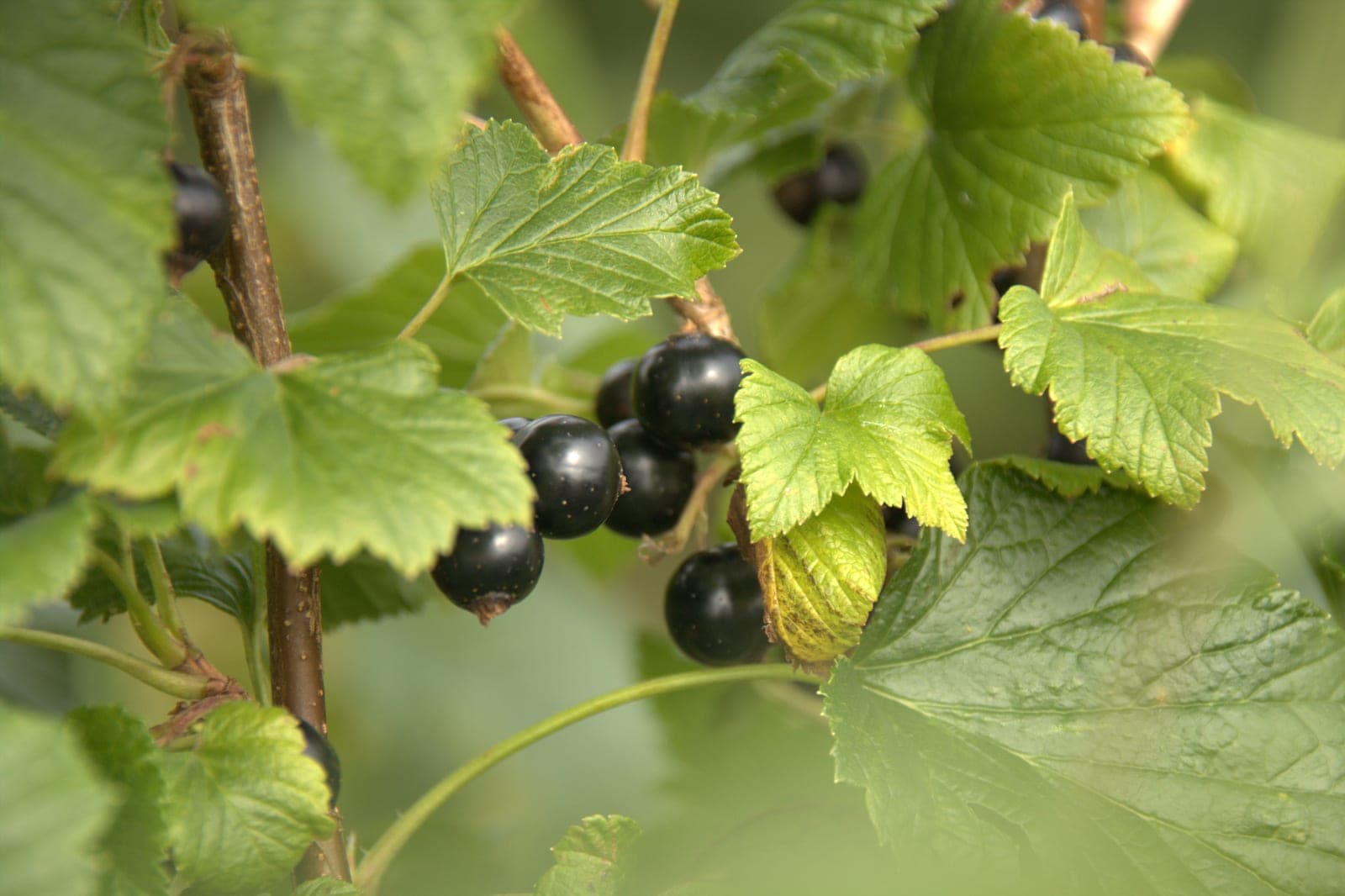
Black Currant
Ribes nigrum
Unity, symbiosis, rejection of contradictions
Botany
The blackcurrant, Ribes nigrum L., is a deciduous shrub that grows between 0.8 and 1.5 m high. It belongs to the family Grossulariaceae (currant family). Most people know the blackcurrant for its edible brown-black to deep black berries, which have a distinctive flavour that is not to everyone's liking: you either love the aroma or you totally reject it. There seems to be no middle ground. The plant forms upright branches that are initially light but later become blackish and barked. These bear the coarsely serrated, 3–5-lobed leaves of the plant. The middle lobe of the leaves is noticeably larger than the other lobes. If you turn the leaves over, you will find yellowish glands regularly distributed on the underside. When crushed, these emit a distinctive scent. A striking feature of this plant is that even the flower buds, the fruits and the bark exhibit this scent. This gives the whole plant an impression of being united as one entity.
Essence
Essence of the plant
Unity, symbiosis, rejection of contradictions
The essence of Ribes nigrum L. symbolises the desire for a symbiotic unity with like-minded individuals, in which contradictions and opposites cannot be accepted. The Ribes nigrum type suffers from the polarity and contradictions of life and longs for unconditional love. In the positive expression of this essence, we recognise character traits such as a tendency to preserve, maternal embrace, devotion, and beneficial generosity.
In the exaggerated, negative form, we see greed, selfishness, and possessive tendencies. The essential forces of Black Currant support people with the described need for unity and merging in the painful experiences that inevitably arise from encounters with contradictions and opposites.
Like all kidney plants, Ribes nigrum L. represents the active, conscious orientation towards fellow human beings. Taking this plant can sharpen awareness that all people are connected and that true humanity is only possible in community. Possessive, hurtful behaviour that contradicts this fundamental principle can be better recognised.
Ribes nigrum
Black Currant
From shape to healing power
The Blackcurrant is notable for how little it polarises and differentiates. This is reflected in the fact that leaves, flower buds, flowers, fruits, and bark all share an identical scent. The scent is determined by the essential oil found in these plant parts. However, unlike most plants, this oil is not produced and stored in the cells of the plant parts, but in so-called glandular hairs, which more or less densely cover the surface of the plant.
On the leaves, the glandular hairs appear only on the underside. This can be easily tested: the typical aroma only develops when rubbing the underside of the leaves. From this distribution of aromatic substances, we can infer that the essence of the Blackcurrant has something connective on the surface? Interestingly, people react very differently to the aroma.
Many perceive the scent as very pleasant and harmonious, while others find it disgusting and repulsive. Because some people associate the scent with that of stinking bugs, the shrub is commonly known as the stink bug bush. When producing the essential mother tincture from Ribes nigrum L., it becomes clear that this plant has very different properties from others. After the milling and dynamisation process in the mortar grinder, the preparations are placed in stoneware pots, where they remain for about 10 days and are stirred daily.
When stirring with a wooden spatula, the properties of the individual plants become clearly apparent. The normal case is that the ground plant parts bond together, forming a cohesive paste. With the Blackcurrant, however, one can feel how the individual leaf parts are completely unconnected and how layers slip alongside each other. In this property, you can see that rejecting polarity cannot lead to unity.
A genuine connection is created through the acceptance of opposites. A single Ribes shrub has little radiance. Due to these essential characteristics, the leaves of the Blackcurrant are rarely used as a single remedy. Their true qualities only emerge when combined with another plant remedy acting in the same direction.
Organic and Demeter cultivation
Blackcurrant is native to Northern and Central Europe as well as Northern Asia and grows in damp forests, floodplains, and along stream banks. As a cultivated plant, it is grown worldwide for its fruit and pharmaceuticals.
Ceres uses leaves of Blackcurrant from organic and Demeter cultivation. The leaves are harvested in early summer when they are fully developed and aromatic-fresh.
Traditional use
In traditional medicine, leaves of berry bushes were used for many different ailments. For example, the leaves were applied locally to wounds for wound healing or placed on the head for migraines. The leaves of blackcurrant are attributed with diuretic and anti-inflammatory effects. Internally, the plant is used to increase urine output and supportively in cases of arthritis, rheumatism, and gout. Supportive treatment for rheumatic and mild urinary tract complaints has become established in herbal medicine to this day. Blackcurrant is particularly common in gemmotherapy as a "plant cortisone" and is one of the most widely used anti-inflammatory agents.
Sources
1. European Scientific Cooperative On Phytotherapy (ESCOP). ESCOP Monographs. (Georg Thieme Verlag, Rüdigerstrasse 14, D-70469 Stuttgart, Germany and Thieme New York, 333 Seventh Avenue, New York NY 10001, USA, 2003).
2. Hänsel, R., Keller, K., Rimpler, H. & Schneider, G. Hagers Handbuch der Pharmazeutischen Praxis Band 5 Drogen P-Z. (Springer Verlag Berlin Heidelberg, 1994).
3. Wichtl, M. et al. Teedrogen und Phytopharmaka. (Wissenschaftliche Verlagsgesellschaft GmbH, Stuttgart, Deutschland, 1997).
4. Committee on Herbal Medicinal Products (HMPC). Assessment Report on Ribes nigrum L. folium. EMA/HMPC/745347/2016 (2017).
5. Roth, C. Gemmotherapie - Die Knospenmedizin. Dtsch. Heilpraktiker Zeitschrift 3, 18–21 (2013).
6. Staszowska-Karkut, M. & Materska, M. Phenolic composition, mineral content, and beneficial bioactivities of leaf extracts from black currant (Ribes nigrum l.), raspberry (rubus idaeus), and aronia (aronia melanocarpa). Nutrients 12, 14 (2020).
7. Kalbermatten, R. & Kalbermatten, H. Pflanzliche Urtinkturen. (AT Verlag, Aarau, Schweiz, 2018).
8. Kalbermatten, R. Wesen und Signatur der Heilpflanzen. (AT Verlag, Aarau, Schweiz, 2016).
Ceres mortar process — gentle, cold and complete.
Freshly harvested, hand-picked, ground at room temperature and aged for years. No heating, no pressure - the plant's full vitality is preserved.