The Immune System — a Tool of the Acting Life Force
Markus Engel · 1 October 2023
The immune system is much more than a defensive centre: in traditional herbal medicine, it is regarded as a tool of the organising force — a guarantee of individuality and integrity. Heilpraktiker Markus Engel demonstrates how spagyric antimony remedies and the Ceres mother tinctures of Echinacea and milk thistle strengthen conscious and unconscious defensive capacity.
Within contemporary psychosomatics, numerous interactions between emotional experience (affects, behaviour) on the one hand and the activity of the immune system on the other are now recognised. One of the central properties of the immune system is that it can distinguish between "self" and "non-self." The immune system is not only an autonomous system charged with defence tasks within the organism but is deeply intertwined with the processes of the nervous system and the endocrine system. Through the immune system, the psyche is directly or indirectly involved in the genesis and progression of most medical conditions. Psychological factors can influence the state of defence, manifesting both as strengthening and weakening.
A central principle of ancient Greek natural philosophy states: "Nature does nothing without reason." This perspective relates to the goal- and purpose-orientation of natural processes (teleology, entelechy). In relation to the life processes in humans, it concerns the concepts of organising force and the planning entity, which reside in the immaterial soul body (Anima). Ultimately, the organising force implements the plans of the Anima into appropriate bodily functions serving both the physical and the higher life.
The organising force unites organ functions and the life processes active within them into a meaningfully organised whole (body, soul and spirit).
Organs and functional areas of the organising force include, among others:
- Regeneration
- Growth and maturation
- Homeostasis (construction, deconstruction and reconstruction)
- Psyche
- Immune system and immune competence
- Endocrine system
- Nervous system
Within the conceptual frameworks of Thomas Aquinas, Leibniz's monad theory, vitalism (life force), and J. W. von Goethe, we encounter entelechy as a conceptual idea — having its purpose within itself in the sense of an inherent force in the organism leading to self-realisation (development).
Immune system & organising force
The life force (Vis vitalis) is a central part of the organising force and is therefore always also part of the soul forces. The organising force preserves the individuality and identity of the human being in their relation to the life environment (boundary and boundary formation). Thus, for traditional naturopathy, the immune system is also a tool of the organising force, an organ or instrument of the active life force.
The active immune system confers integrity and continuously prevents the organism from being overwhelmed, disintegrated and dissolved in the world's engagements. Thus, the human immune system becomes a guarantor of the ability to have one's own life and ultimately forms the basis for one’s individuality.
Since we have also described the organising force as a soul force [1], we can infer a close connection between soul life and immune processes (immune competence). The affects and stirrings of soul activities deeply influence immune functions and always also in the opposite direction. An increased or decreased effect and activity of immunological processes always reflect in the soul forces (see also the emerging field of psycho-neuro-immunology).
"An increased or decreased effect and activity of immunological processes always reflect in the soul forces."
Thus, a long-standing depressed mood, ongoing grievances and conflicts can manifest as heightened susceptibility to infections and furthermore lead to other vulnerabilities of the immune system.
Similarly, an overstraining of the immune system can have a feedback effect on the nervous system (Fig. 1) and be associated with altered stimulus conditions, inhibition of thoughts and limbs (depressive mood), and a lack of joy and zest for life, ultimately having its causes in the immune system as well.
Disorders of defence capability in the highly networked regulatory circuits of boundary activities thus are always also disturbances in immune potency. In patients’ histories and disease courses, clear indications of these connections can repeatedly be found. A disease then breaks out when the strategy of defensive conflict resolution collapses.
Stimulation and modulation of immune forces by vitalising medicinal powers
In spagyric medicine according to Alexander von Bernus, antimony preparations play a central role. Within Soluna spagyrics, Solunat No. 3 (Azinat) is regarded as the fundamental remedy for every therapy. In a 1928 vade mecum on the Solunats, Alexander von Bernus writes: "Azinat was one of the main remedies of Paracelsus and especially of Basilius Valentinus. It is recommended to prescribe Azinat alongside the relevant specialised remedies for most acute and chronic diseases. Azinat is particularly a first-rate remedy in all epidemic diseases […]. For all chronic diseases based on fluid corruption, Azinat in alternation with Dyscrasin (Solunat No. 6) is the main remedy."
Alongside the seven traditional planetary metals, a special metal is also assigned to the earth itself. Antimony as the "eighth" metal was considered a universal remedy in Paracelsus’s time, seen as a renewer of life. The most common form in nature is stibnite (antimony sulphide, Antimonium crudum); in this form antimony reveals its affinity to sulphur, which also has the role of "mediator between the spiritual and its formative power and the physical" (Mercury principle). This refers to the aforementioned organising force, into which antimony powers intervene structurally.
Solunat No. 3 (Azinat) is used in all inflammatory affections, especially at the organism's interfaces. Besides the spagyric antimony distillates, the formula also contains Natrium nitricum (Rademacher’s "universal remedy") against inflammation, followed by potassium bitartrate and silicic acid — both related to the action on inflammatory exudations.
In relation to allergy, Solunat No. 3 has a stabilising effect on immune system processes. To balance the excessive immune response in allergic reactions, a lower dosage has proven effective (e.g. twice daily 5 to 8 drops taken in a little water).
As on the day the world endowed you, The sun stood to greet the planets, You promptly and continually grew. According to the law by which you began. So you must be, you cannot flee yourself. This was said by sibyls, by prophets; And neither time nor power can destroy a shaped form that develops living.
(Johann Wolfgang von Goethe, 1817)
Another important antimony preparation is the one assigned to the spleen, Solunat No. 18 (Splenetik): Here we arrive at weaknesses of the life force, chronic diseases and ultimately the increasing lack of energy that can accompany a generally reduced healing tendency. This is accompanied by a tendency toward hardening, expressing a lack of impulse (fire quality) and energy (moisture), which can ultimately manifest as a lack of immune strength (tendency to degenerative diseases). The Saturn-associated Solunat No. 18 (Splenetik), with its broad spleen reference, is the "resolving, melting" remedy: It dissolves physical and psycho-spiritual hardenings, eliminates Tartarus (deposits due to an overemphasis on cold processes) and thereby generally increases the life force and thus also the immune strength (relation to the blood and lymphatic system).
Another therapy I greatly appreciate in practice is the use of plant-based, essential mother tinctures from Ceres.
Conscious and unconscious defence ability
The unconscious defence ability – Echinacea
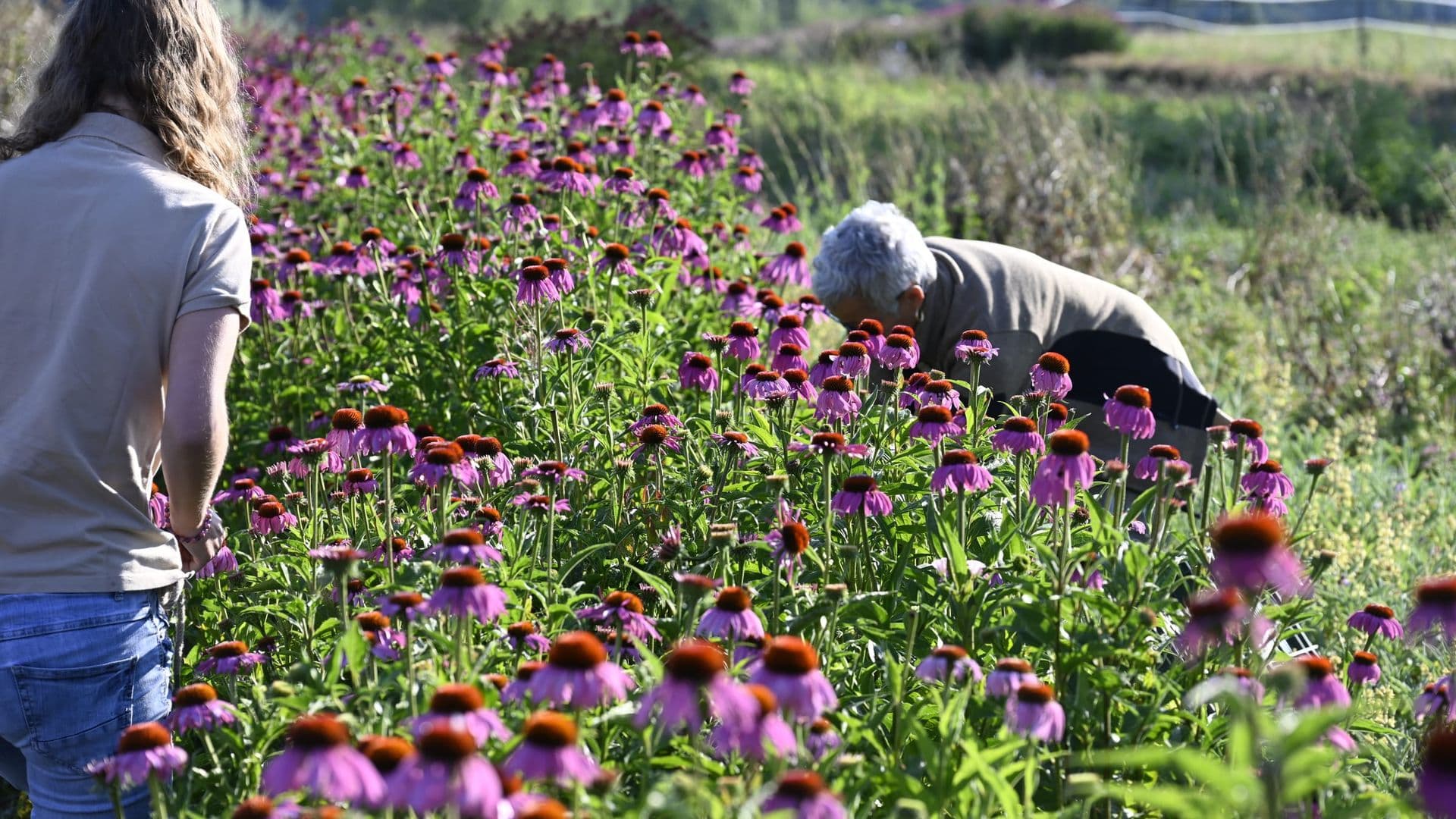
Ceres Echinacea purpurea Ø (Sonnenhut mother tincture). Essence of the plant: shielding, delimitation, protective skin. It is the domed flower receptacle with its spiky bracts that gives the plant its characteristic appearance and name (from Greek „echinos" = hedgehog). The flower crown with its purple ray florets, which fully bend downwards at full bloom, hides through this passive gesture its green involucre (shielding of the outer flower skin) from the view of others.
The spiky signature of the flowers shows that the plant can protect itself. In direct contact with the plant, it is seen that the defence of the flower crown, when pressed with the palm, leaves a stimulating sensation but causes no stings. It is the absence of an aggressive component that points to the unconscious protection of the immune system.
A similar gesture is found in the flower crown turning completely downward, creating the image of an umbrella (passive protection). The effect of Echinacea can be described as a protective skin helping the person to develop a psychological immunity (alongside its immune-stimulating effect) towards the many small imperfections of life [2].
The conscious defence ability – Milk thistle
Ceres Carduus marianus Ø (Milk thistle mother tincture). Essence of the plant: boundary, protection, individuality. The leaves and floral bracts are equipped with extremely sharp thorns that painfully penetrate everything. One approaches this impressive appearance with caution. After flowering, the central tubular flowers lay around and stick together to form a dense roof under which the fruits of the plant can mature. Preserving unmistakable individuality through appropriate delimitation expresses this strong plant personality with its characteristic features.
Milk thistle involves an active, conscious delimitation, in contrast to Echinacea, which knows how to shield unconsciously (immune system) against harmful influences rather than through a conscious willful act (aggressive gesture). The strong reference of milk thistle to the liver organ (liver activity: relation to the water element; bile activity: relation to the fire element) points to the connection that psychological defence weakness can manifest in opposing ways – in the inability to set boundaries and say no, or in an exaggerated aggressive delimitation. These weaknesses always affect liver and gallbladder function and cause disruptions of detoxification and excretion functions (congestions), which in turn can be seen in connection with the development of chronic diseases.
Sour milk whey and right-rotating lactic acid
Through an old article on the so-called whey cures in the 18th and 19th centuries, I became aware of the medicinal product Lactisol from Galactopharm Dr. Sanders. Lactisol is a sour milk whey concentrate refined through multiple fermentations with lactic acid bacteria and matured over six months into an effective medicinal product. The central site of action is the mucous membranes of the digestive system in the mouth, throat, stomach and intestines as well as the associated gut-associated immune system. In many diseases for which milieu therapy is indicated (digestive disorders, strengthening mucous membrane systems, detoxification therapies, accompaniment in cancer diseases etc.), Lactisol has proven effective in stimulating and modulating the body's own defence power.
"Today we know about the deep interconnection of the psychic level and the immunological regulatory circuits of humans (psychoimmunology)."
Conclusion
Today, we know about the deep interconnection between the psychic level and the immunological regulatory circuits in humans (psychoimmunology). Any conflict processing at the level of various cells in our immune system takes place only after clarifying and resolving the self (boundary and alert encounter) with what no longer fits, and recognising one’s own needs (aspects of self-authenticity), before a defence strategy can be adopted. Perceiving the person behind the person and finding a suitable language with the patient for their concerns (conflict resolution), together with vitalising medicinal products, can repeatedly help strengthen immunity and, thus, a person’s integrity for nourishing encounters with the world in today's times.
Author
Markus Engel has worked since 1998 as a Heilpraktiker with specialisations in Western medicine, phytotherapy, spagyrics, homeopathy (miasmatics), systemic counselling and structural constellations (SySt). He is a member of the scientific advisory board of FAKOM. In addition, he conducts seminars and lectures, is the author of numerous specialist articles and a longstanding consultant and collaborator for naturopathically oriented pharmaceutical companies.
Contact: info@heilpraktiker-engel.de
Literature
[1] Treichler R. Die Entwicklung der Seele im Lebenslauf: Stufen, Störungen und Erkrankungen. Stuttgart: Verlag Freies Geistesleben, 1981.
[2] Kalbermatten R, Kalbermatten H. Psyche des Menschen und Signatur der Heilpflanzen. Baden und München: AT Verlag, 2020.
[3] Kalbermatten R, Kalbermatten H. Pflanzliche Urtinkturen: Wesen und Anwendung. Baden und München: AT Verlag, 2005.
[4] Casagrande C. Praxis Spagyrik: Nach Alexander von Bernus (2. Aufl.). Stuttgart: Haug Verlag, 2012.
[5] Husemann F, Wolff O. Das Bild des Menschen als Grundlage der Heilkunst, Band II und Band III. Stuttgart: Verlag Freies Geistesleben, 1986.
[6] Lanninger-Uecker O. Blut als Heilmittel: Grundlagen und Methoden der Eigenbluttherapie. Stuttgart: Sonntag Verlag, 2003.
[7] Mayer A. Traditionelle Europäische Medizin. Augsburg: Foitzick Verlag, 2013.
[8] Hoffmann SO, Hochapfel G. Neurosenlehre, Psychotherapeutische und Psychosomatische Medizin (6. Aufl.). Stuttgart: Schattauer, 1999.
Source: CO.med – Magazine for Complementary Medicine, 29th Year, October 2023, pp. 20–23.
Continue on Ceres channels
These links open the respective platforms directly. They are intended as a supplement to the article, not as a native in-page interaction.