Milk Thistle
Silybum marianum
Demarcation, protection, individuality
Botany
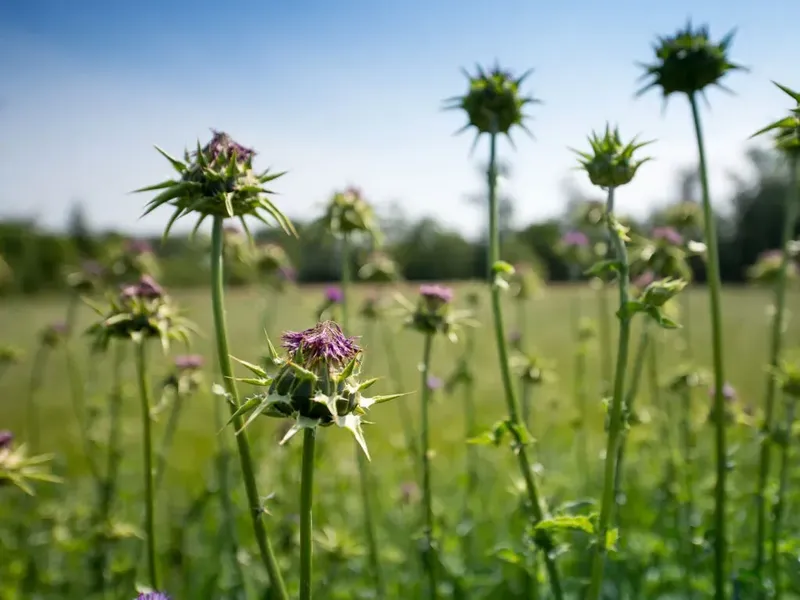
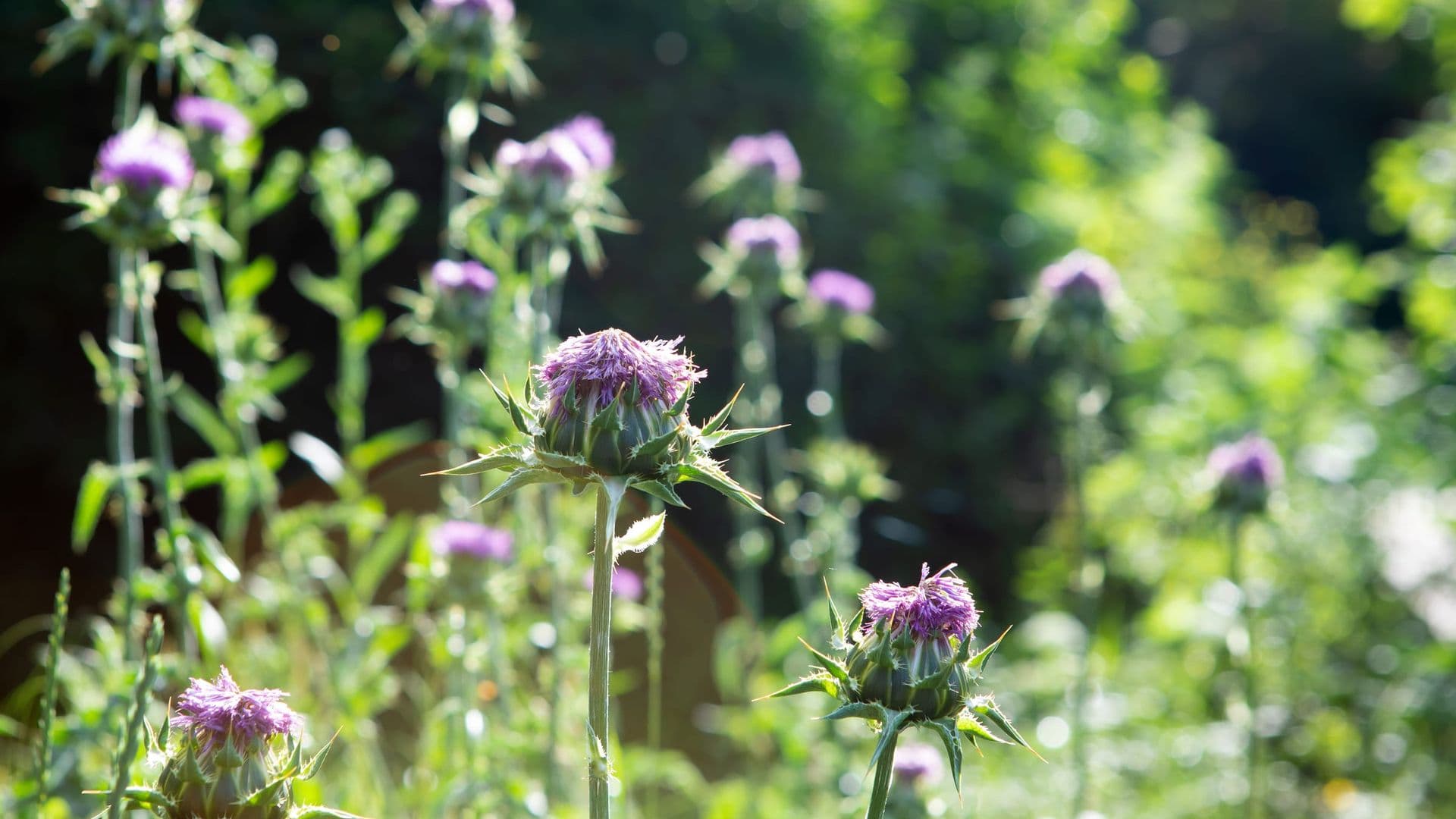
The milk thistle, with the botanical name Silybum marianum (L.) GAERTN., belongs to the family of Asteraceae. It is an annual, rarely biennial plant that can develop an imposing plant form up to 2.50 m in height. After germination, it first develops a taproot and a rosette lying flat on the ground. From this rosette, a strong upright stem then arises, which branches roughly from the middle. On the stem are the elongated-elliptical, lobed pinnate leaves. All leaves of the plant have several special features: Firstly, they are not purely green as is typical for plant leaves; they have areas where chlorophyll is absent and are consequently ‘coloured’ white. Moreover, the leaves are not flat as would be typical; instead, they are three-dimensionally arched, resulting in a wavy leaf edge. Above all, the leaf edge is armed with yellowish thorns that are very long and sharp. An unintended encounter with the milk thistle is not easily forgotten! At the tips of the stems sit the purple-coloured, 4 to 6 cm large, egg-shaped flower heads, which consist exclusively of tubular flowers. The inflorescences, which bloom from June to August, are also armed with sharp thorns. After flowering, when the fruits of the plant begin to mature, the tubular flowers fold back, stick together, and form a roof over the fruits to protect them from moisture.
Essence
Essence of the plant
Demarcation, protection, individuality
Milk thistle promotes the ability to assert oneself appropriately against emotional and physical exploitation, as well as against attacks and manipulation. It supports the preservation of one's own personality by strengthening active boundaries against harmful psychological influences.
It should be noted that a psychological defence weakness can manifest in opposite ways, either in the inability to set boundaries and say no, or in an excessive, aggressive boundary-setting. Such a weakness can lead to a disturbance of the liver's detoxification and excretion functions and thus be the cause of chronic illnesses.
Silybum marianum
Milk Thistle
From shape to healing power
The milk thistle prefers warm, dry locations; it originates from the Mediterranean region, where it is widespread. In Central Europe it is occasionally cultivated. The milk thistle is a strong plant personality. With its stately size and extremely defensive spines, it commands respect and keeps humans and animals at a safe distance.
With its characteristic two-toned, tough leaves, it bears the mark of pronounced individuality: it cannot be overlooked or mistaken. Anyone who has seen a milk thistle once will never forget it. The signature of the milk thistle clearly expresses the essence of protection, boundary-setting and individuality. Like many other thistle species, it is armed with spines on the flower heads and leaves.
The defence function is as perfected as hardly any other thistle. Even with light contact, the spines penetrate the skin. They are so sharp, hard and long that approaching the plant can only be done with utmost caution. When harvesting the ripe flower heads, this defensiveness is often painfully felt despite protective clothing.
The leaves are very firm, glossy and appear persistent like the leaves or needles of hardy winter plants. The characteristic colouring of the leaves is the surest identifying feature of the milk thistle. The rich green is overlaid along the leaf veins by a network of broad white stripes marking the veins.
Thus the actual leaf green lies like islands scattered within this white band network. One can clearly recognise distinct colour zones in the leaves. The leaf edge is indented inwards and raised far beyond the leaf surface so that the leaf area and the leaf boundary are noticeably enlarged and emphasised. A gentler form of defence and protection is found inside the flower heads.
The purplish, slightly sticky tubular flowers undergo a surprising transformation after fading. The colour changes from purple through blue to grey. At the same time, the small, tubular petals – starting from the centre of the heads – fold radially outwards and stick together. In this way, they form a rainproof roof as a protection for the ripening fruits, which looks like a perfect, conical thatched roof.
Organic and Demeter cultivation
Milk thistle originates from the Mediterranean region and Western Asia and is now widespread worldwide. As a ruderal plant, it grows on rubble sites, road edges, and fallow land. It is cultivated on a large scale pharmaceutically in Eastern Europe (Hungary, Poland), Austria, and Germany.
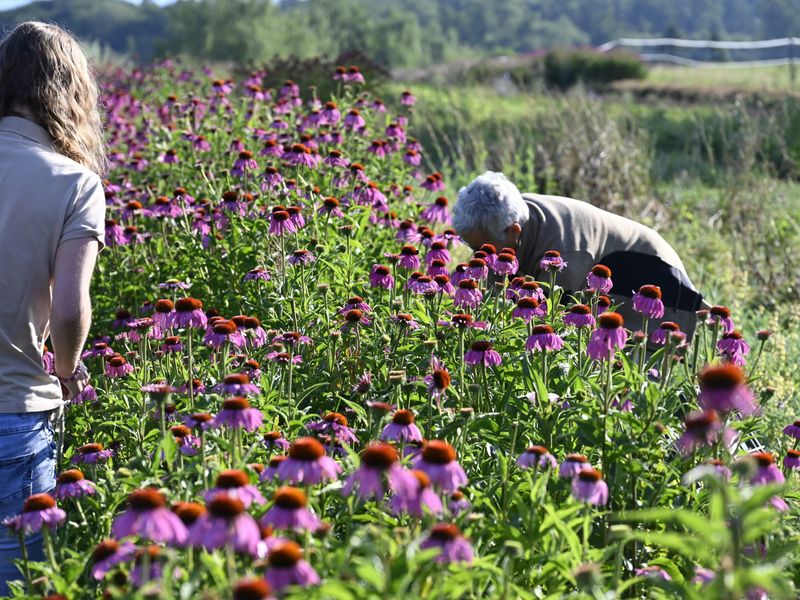
Ceres uses milk thistle fruits from organic and Demeter cultivation. The fruits are carefully hand harvested in summer after ripening and then gently dried.
Traditional Use
Milk thistle is known as one of the main remedies for diseases of the liver and bile ducts. Typical areas of application include dyspeptic complaints and toxic liver damage. Liver-related headaches, nausea, digestive disorders and varicose veins are regarded from a herbal medicine perspective as well-established areas of application. Milk thistle is also used homeopathically for liver-gall diseases. Furthermore, milk thistle is applied according to the homeopathic medicinal profile for haemorrhoids and varicose vein conditions, as well as for rheumatism of the shoulder and hip. Herbal preparations made from milk thistle fruits are used supportively in chronic inflammatory liver diseases and liver cirrhosis. Silybum marianum (L.) GAERTN. is one of the particularly well-studied medicinal plants. The protective effect on liver cells is explained by the following three properties: stabilisation of the liver cell membrane, radical scavenging and antioxidant function, and acceleration of liver cell regeneration. Thus, milk thistle has the potential to counteract exposure to liver-damaging substances. This property is utilised in the application of silibinin in cases of death cap mushroom poisoning.
Sources
1. Hänsel, R. & Steinegger, E. Hänsel / Sticher Pharmakognosie Phytopharmazie. (Wissenschaftliche Verlagsgesellschaft GmbH, Stuttgart, Deutschland, 2015).
2. Committee on Herbal Medicinal Products (HMPC). Assessment report on Silybum marianum (L.) Gaertn., fructus. European Medicines Agency (2018).
3. BGA/BfArM (Kommission E). Cardui mariae fructus ( Mariendistelfrüchte ). Bundesanzeiger 50, (1986).
4. Madaus, G. MADAUS LEHRBUCH DER BIOLOGISCHEN HEILMITTEL BAND 1-11. (mediamed Verlag, Ravensburg, 1990).
5. Committee on Herbal Medicinal Products (HMPC). European Union herbal monograph on Silybum marianum (L.) Gaertn., fructus Final. (2018).
6. BGA/BfArM (Kommission D). Silybum marianum (Carduus marianus). Bundesanzeiger 129 a, (1985).
7. Kalbermatten, R. & Kalbermatten, H. Pflanzliche Urtinkturen. (AT Verlag, Aarau, Schweiz, 2014).
8. Kalbermatten, R. Wesen und Signatur der Heilpflanzen. (AT Verlag, Aarau, Schweiz, 2016).
Conscious Resilience
R. & H. Kalbermatten — «Psyche des Menschen und Signatur der Heilpflanzen»
Ceres mortar process — gentle, cold and complete.
Freshly harvested, hand-picked, ground at room temperature and aged for years. No heating, no pressure - the plant's full vitality is preserved.