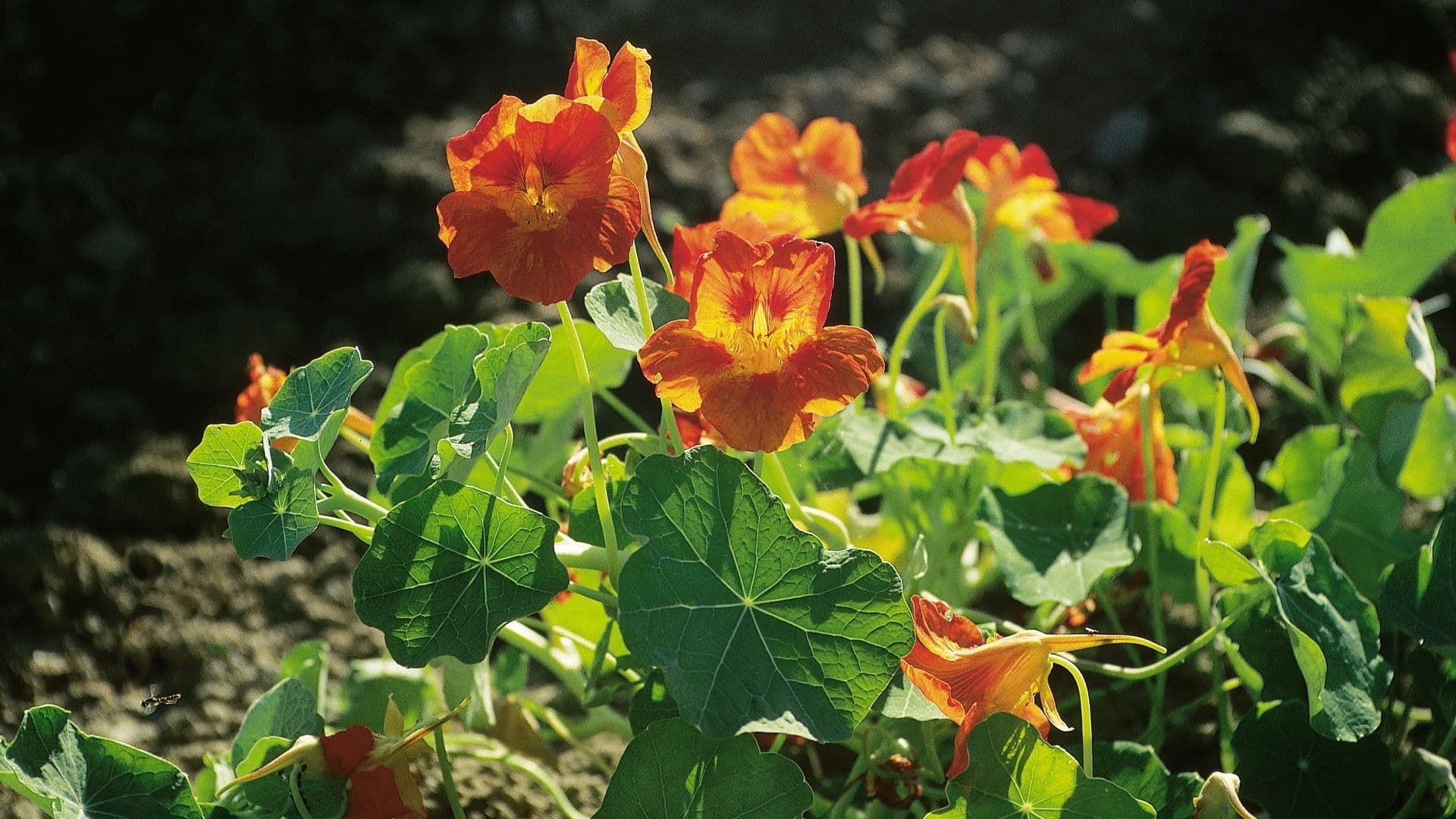
Nasturtium
Tropaeolum majus
Warming up of the aqueous and luminous penetration of the dark and moist
Botany
The Greater Nasturtium, Tropaeolum majus L., is an annual, non-hardy plant in Central Europe. It actually originates from the warmer regions of South America, but today is widely cultivated in Central Europe as an ornamental or utilitarian plant. The large, slightly fleshy leaves are striking at first glance. Their characteristic round, shield-like leaf shape arises because the leaf stalk attaches in the centre of the leaf blade, not at the bottom. The leaf itself is water-repellent due to its structure, which causes rainwater to quickly bead off. The entire plant is very "moist" and has a very high water content. The nasturtium quickly overgrows bare ground with its tendrils, which can reach several metres in length, completely covering it. From about June until October, first single, then increasingly many large, bright yellow, red or orange flowers appear. These often grow beneath the shield-shaped leaves and are thus covered by them. Sampling the leaves or the flowers reveals that both parts have a very intense, sharp flavour.
Essence
Essence of the plant
Warming up of the aqueous and luminous penetration of the dark and moist
Fire (light and warmth) and water are the fundamental elements of life. Every form of life thrives only in a specifically balanced relationship of fire and water. For terrestrial organisms: if water is lacking, living beings wither; if water is in excess, they "drown".
Fire regulates these relationships. The element fire is inherently warm and dry, the element water is wet and cold. The degree of intervention of the fire element (sun) creates the conditions of warmth and cold as well as dryness and moisture adapted to each life form.
These elements also carry a higher significance. Fire stands for consciousness or self-force, water for life force. Nasturtium acts as a regulating power to bring about the right, appropriate union of the fiery with the watery.
It "tempers" the water, permeates life with powers of consciousness, connects the warmth element with the cold and wet, and in this way leads to a revival of areas in the body and consciousness that have fallen out of the life process. The Nasturtium type may find themselves on the shadow side of life, the place in the sun always already occupied. They grant other people too much power.
However, they also like to hide behind the back of a stronger person, going through life in their slipstream. This contains a certain timidity to face life. They lack the constant warmth of healthy self-confidence.
This human type secretly admires and envies the success of the strong. They share in the slipstream and identify with the successful. They themselves do not dare to present their ideas to the world, even though there is much creativity within them.
In their innermost being they know their worth, but they lack the courage, the character strength, the charisma to step forward externally. The described human type can be prone to chronic infections (e.g. of the urinary tract). Nasturtium supports them in the release of warming forces.
Tropaeolum majus
Nasturtium
From shape to healing power
Nasturtium belongs to plants with a particularly expressive signature. Its leaves are actually not those of a terrestrial plant. The leaf stalk is fused with the centre of the leaf blade, so that the almost circular leaf resembles a shield. Usually, the leaf stalk is fused with the base of the leaf blade, even when the leaf spreads completely round, as with Alchemilla. This structural principle of the leaf otherwise only occurs in some aquatic plants whose leaves float on water. Here we already recognise a central aspect of the signature: The terrestrial plant Nasturtium expresses through its leaves the character of an aquatic plant, and the leaf surfaces effectively mark the water surface. However, Nasturtium has very light- and heat-oriented flowers, which are not found in aquatic plants.
The large, beautifully shaped flowers are bright yellow, radiant orange and fiery red. Many other plants also bear light-oriented flowers that tend to face outwards, towards the light. In Nasturtium, the opposite situation is found.
The radiant flowers are repeatedly overgrown by the leaves and pushed into darkness. Although the plant produces new flowers again, these suffer the same fate. This often creates the astonishing image of the light-filled flowers glowing quietly in the dark, completely covered by the leaf shields. Since, as explained above, the leaf surfaces can be seen as the “water surface,” the essence of the plant is thus recognised as the penetration of light through moisture.
Demeter cultivation
Nasturtium originates from the Andean regions of South America and is now cultivated worldwide as an ornamental and medicinal plant. It prefers sunny locations with well-drained, moderately nutrient-rich soil.
Ceres uses fresh nasturtium from Demeter cultivation. The fresh flowering herb is harvested by hand in summer.
Traditional Use
Nasturtium, Tropaeolum majus L., has an antimicrobial effect and is used to support the treatment of infections of the lower urinary tract and catarrhs of the upper respiratory tract. The textbook of biological medicinal products by Dr. med. Gerhard Madaus cites chronic bronchitis as the main area of application. The pharmacological properties are particularly based on the effect of benzyl isothiocyanates.
Sources
1. Madaus, G. MADAUS LEHRBUCH DER BIOLOGISCHEN HEILMITTEL BAND 1-11. (mediamed Verlag, Ravensburg, 1990).
2. BGA/BfArM (Kommission E). Tropaeolum majus (Kapuzinerkresse). Bundesanzeiger 162, (1992).
3. Hänsel, R., Keller, K., Rimpler, H. & Schneider, G. Hagers Handbuch der Pharmazeutischen Praxis Band 5 Drogen P-Z. (Springer Verlag Berlin Heidelberg, 1994).
4. Kalbermatten, R. & Kalbermatten, H. Pflanzliche Urtinkturen. (AT Verlag, Aarau, Schweiz, 2014).
5. Kalbermatten, R. Wesen und Signatur der Heilpflanzen. (AT Verlag, Aarau, Schweiz, 2016).
Warming of the Watery
R. & H. Kalbermatten — «Psyche des Menschen und Signatur der Heilpflanzen»
Ceres mortar process — gentle, cold and complete.
Freshly harvested, hand-picked, ground at room temperature and aged for years. No heating, no pressure - the plant's full vitality is preserved.