Eyebright
Euphrasia officinalis
An eye for perceiving the obvious, finding meaning
Botany
The two eyebright species Euphrasia stricta and Euphrasia rostkoviana belong to the family of broomrape (Orobrancheae). Both can be found in meadows and pastures, often at higher altitudes and on nutrient-poor, infertile sites. If the meadows are fertilised, eyebright quickly disappears. Both species grow 5 to 30 cm tall; they are small but clearly visible. The stems stand erect and are branched with long, upright branches. Euphrasia stricta is shortly hairy, Euphrasia rostkoviana is covered with glandular hairs. The leaves are ovate.
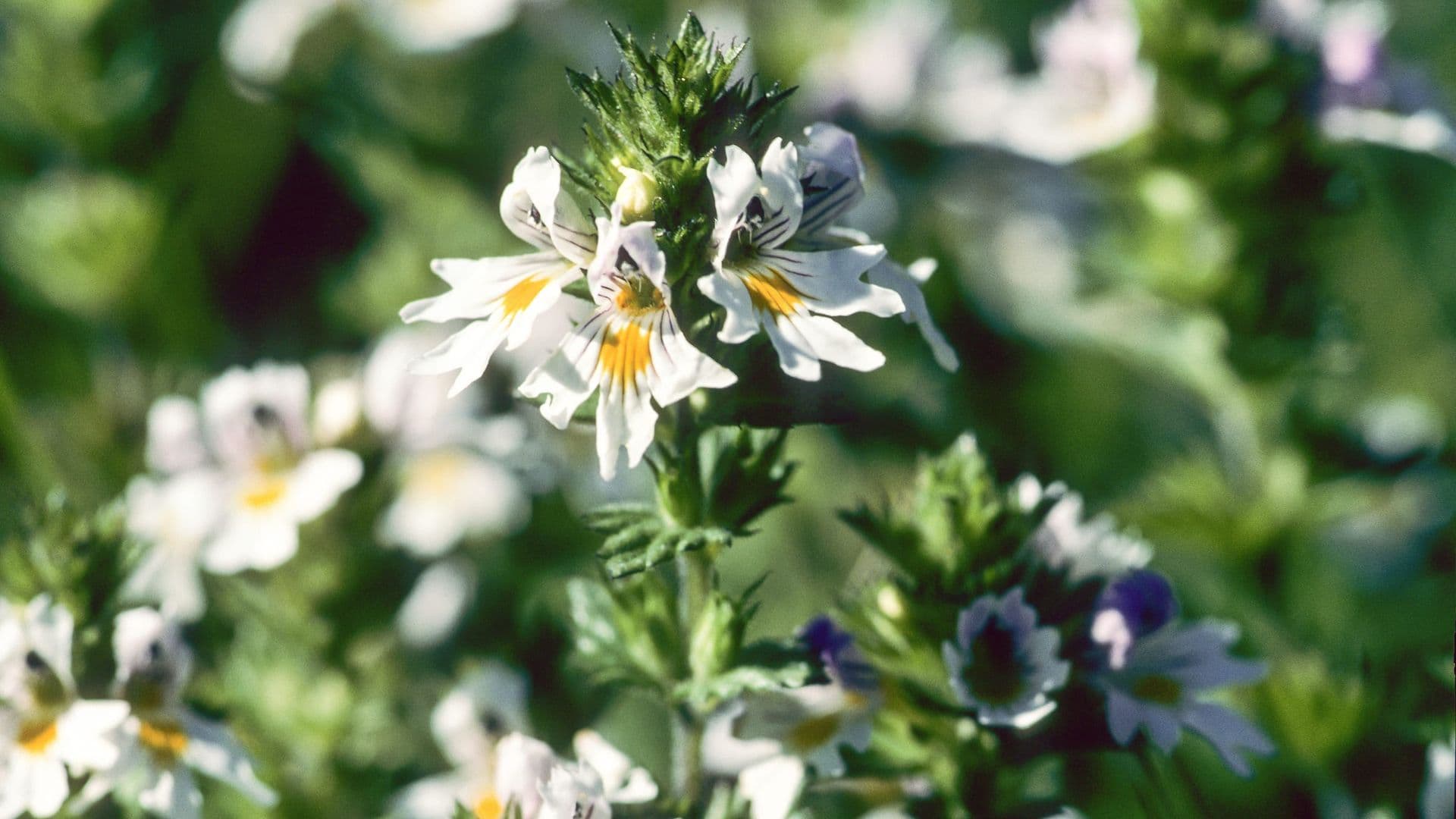
Both species flower in summer and autumn. What is interesting about Euphrasia is that the flowering phase and the vegetative growth phase do not inhibit each other — Euphrasia continues to flower while it grows. The relatively large flowers are white, with additional colouring on the upper lip (violet) and lower lip (yellow). The plants are "hemiparasites" and need a connection to the roots of meadow plants. With haustoria, they extract water and nutrients and thus shape their surroundings: the “tapped” plants grow less vigorously, and eyebright thus ensures its own visibility.
Essence of the plant
An eye for perceiving the obvious, finding meaning
The eyes are commonly referred to as the windows to the soul. In fact, one could describe the bright glow of a group of Euphrasia as a window to another world, to the inner earth. Euphrasia is among the plants whose optical effect is primarily achieved through grouping, in the combination of many individuals.
A group of Euphrasia emits an intense vitality, a radiance. This intense light can be associated with the fire within the earth, with the heart of the earth. The earth lives, it shines and wishes to be perceived.
Often, people do not notice how far they have moved away from their "location," so focused are they on moving forward. They no longer consciously maintain their relationship with nature, with planet earth, which noticeably also affects the eyes.
Visual acuity deteriorates, conjunctivitis can develop, as the eyes are overstrained and damaged, especially in front of screens. Euphrasia works effectively against eye fatigue and foreign body sensation. Moreover, it has the ability to impart a new, more intense perspective towards life.
It opens the eyes to the spiritual principle behind things, to the beauty of simplicity. Euphrasia directs attention to the nearby, the radiance at our feet. It conveys cheerfulness through simplicity, through the power of the elemental, and helps strengthen both inner and outer vision.
Euphrasia officinalis
Eyebright
From shape to healing power
Eyebright (Euphrasia officinalis) is very common on meadows in the montane and alpine altitude zones. The beautiful flowers of this small plant are striking. Eyebright is one of the plants frequently cited in literature as an example of the – admittedly, in our view trivial – doctrine of signatures, i.e. the idea that a plant’s effect on an organ is indicated by a conspicuous similarity to that organ. Eyebright could indeed be such an example, but a far stronger argument for its well-known effect on the eyes is the fact that it is a hemiparasite.
Although eyebright has green leaves that assimilate light, it cannot produce all the energy (both material and etheric) it needs through photosynthesis alone. The plant’s vitality is therefore severely reduced, which is also manifested by the fact that it breaks down and decomposes very rapidly after harvest. The tincture is a deep dark brown, almost black, indicating intensified degradation processes. Opposed to this limited vitality is a strong connection of the flowers with light and colour, representing a counterbalance. In eyebright, we find a polarity between emphasised light quality and weakened vitality.
Wild collection (Alps)
Euphrasia is widespread in Europe and Western Asia and grows as a hemiparasite on nutrient-poor meadows, dry grasslands, and heaths — it taps into the roots of grasses without killing them. In Switzerland, it is particularly common on mountain meadows.
Ceres sources Euphrasia from wild collection in Switzerland. The fresh flowering plant is harvested by hand at suitable undisturbed mountain locations during the summer flowering season.
Traditional Use
The areas of application for eyebright, Euphrasia, mainly originate from the field of traditional folk medicine. Both internal and external forms of application are equally common with this medicinal plant. The rather unusual use in the area of the eyes for medicinal plants is well known and appreciated alike in phytotherapy, homeopathy and anthroposophical medicine. The areas of application include inflammatory and allergic complaints, as well as signs of fatigue in the eye area, such as redness, swelling, increased tear secretion, burning, foreign body sensation and eyelid oedema. The medicinal product market offers a number of different Euphrasia eye drops. However, the local application of the herb in the form of compresses, eye baths and rinses is not recommended for hygienic reasons, as, for example, irritating particles from the herb could enter the eye. Under sterile conditions, preparations from Euphrasia are indeed suitable for conjunctivitis, as demonstrated in a study.
Sources
1. Hänsel, R. & Steinegger, E. Hänsel / Sticher Pharmakognosie Phytopharmazie. (Wissenschaftliche Verlagsgesellschaft GmbH, Stuttgart, Deutschland, 2015).
2. Madaus, G. MADAUS LEHRBUCH DER BIOLOGISCHEN HEILMITTEL BAND 1-11. (mediamed Verlag, Ravensburg, 1990).
3. Committee on Herbal Medicinal Products (HMPC). Assessment report on Euphrasia officinalis L . and Euphrasia rostkoviana Hayne , herba. EMA/ HMPC/246799/2009 (2010).
4. Wichtl, M. et al. Teedrogen und Phytopharmaka. (Wissenschaftliche Verlagsgesellschaft GmbH, Stuttgart, Deutschland, 1997).
5. BGA/BfArM (Kommission E). Euphrasia officinalis (Augentrost). Bundesanzeiger 162, (1992).
6. BGA/BfArM (Kommission D). Euphrasia officinalis (Euphrasia). Bundesanzeiger 217a, (1985).
7. Stoss, M., Michels, C., Peter, E., Beutke, R. & Gorter, R. W. Prospective cohort trial of Euphrasia single-dose eye drops in conjunctivitis. J. Altern. Com plement. Med. 6, 499–508 (2000).
8. Kalbermatten, R. & Kalbermatten, H. Pflanzliche Urtinkturen. (AT Verlag, Aarau, Schweiz, 2014).
9. Kalbermatten, R. & Kalbermatten, H. Psyche des Menschen und Signatur der Heilpflanzen. (AT Verlag, Aarau und München, 2020).
Light and Shadow
R. & H. Kalbermatten — «Psyche des Menschen und Signatur der Heilpflanzen»
Ceres mortar process — gentle, cold and complete.
Freshly harvested, hand-picked, ground at room temperature and aged for years. No heating, no pressure - the plant's full vitality is preserved.