Sage
Salvia officinalis
Absorbing capacity, receptivity, yin
Botany
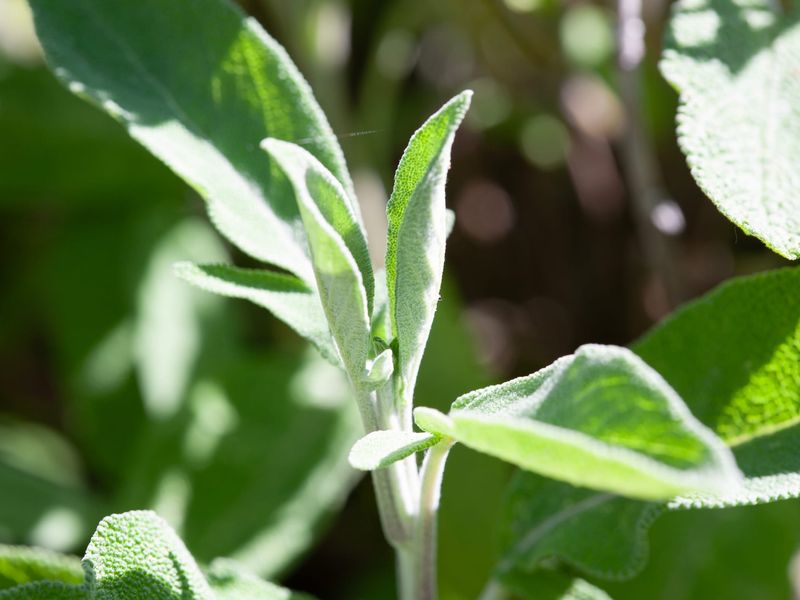
Salvia officinalis belongs to the family of Lamiaceae and is a semi-shrub measuring 20 to 70 cm in height. It is originally a Mediterranean plant and native to dry limestone slopes in Southern Europe. The sage is woody at the base; its ascending, matt green above and herbaceous stems carry oblong-ovate leaves that can grow up to 7 cm long, occasionally with auricles at the base. The leaf surface appears wrinkled above due to the sunken venation, while the venation is prominent underneath. When the leaves are crushed, they are bitter and spicy.
From May to July, sage blooms with blue, violet, sometimes white flowers that are visited intensively by insects. The plant survives the winter with renewal shoots formed in summer.
Essence of the plant
Absorbing capacity, receptivity, yin
The essence of sage supports capacity for absorption and receptivity in both mental and physical respects. There is a connection between the two: a throat infection and associated swallowing difficulties can also be the physical expression of a psychological state in which one has had enough and can no longer swallow anything. Human development repeatedly requires openness to new impulses; transformations, metamorphoses are meant to occur.
The fear of a change to what is familiar and secure creates a blocking effect. A strong resistance to new impulses arises; the person unconsciously wants to grant no further admission to new things; inflammations of the pharynx can be the consequence. For women, the onset of the climacteric marks a life phase in which reorientation takes place.
Their personality seeks expansion; new interests and tasks must be found. It is important in this context to foster receptivity to impulses from within and without.
In this situation, sage strengthens receptivity on the mental level through its essence, which can compensate for declining physical receptivity. Women in menopause appreciate the sweat-inhibiting effect of sage during hot flushes. During the fertile phase of life, the balance of Yin and Yang is maintained through hormone production.
Due to the slowing of hormone production, the balance of Yin and Yang changes during the climacteric. This can lead to a temporary excess of warmth or Yang. Sage can have a cooling and balancing effect here.
Salvia officinalis
Sage
From shape to healing power
There are plants with a relatively simple, clear structure that do not reveal any great peculiarities in their form. Instead, they possess an aroma that is very profound and opens the gateway to their essence. This includes sage, whose aroma is due to its abundant essential oil. The scent of sage belongs to the rather rare aromas whose warmth character is not clearly defined.
Is it warming or cooling? It adapts to different situations and can both warm and cool, which gives it the power to mediate between two worlds. The scent of sage carries us as if through a channel that penetrates the outer layers of being, inwardly. Sage is not a plant of the light.
It stands in complete contrast to plants that have a pronounced relationship to light, such as St John’s wort, marigold, horse chestnut, and eyebright. Those who place sage on their tongue sense the action of an essential force that draws inward, into the dark. In this way, sage creates a connection between outer and inner, light and dark, above and below; it establishes a balance between the forces of heaven and earth. On the physical level, the plant relates to the organs that absorb substances: the throat and the female reproductive organs.
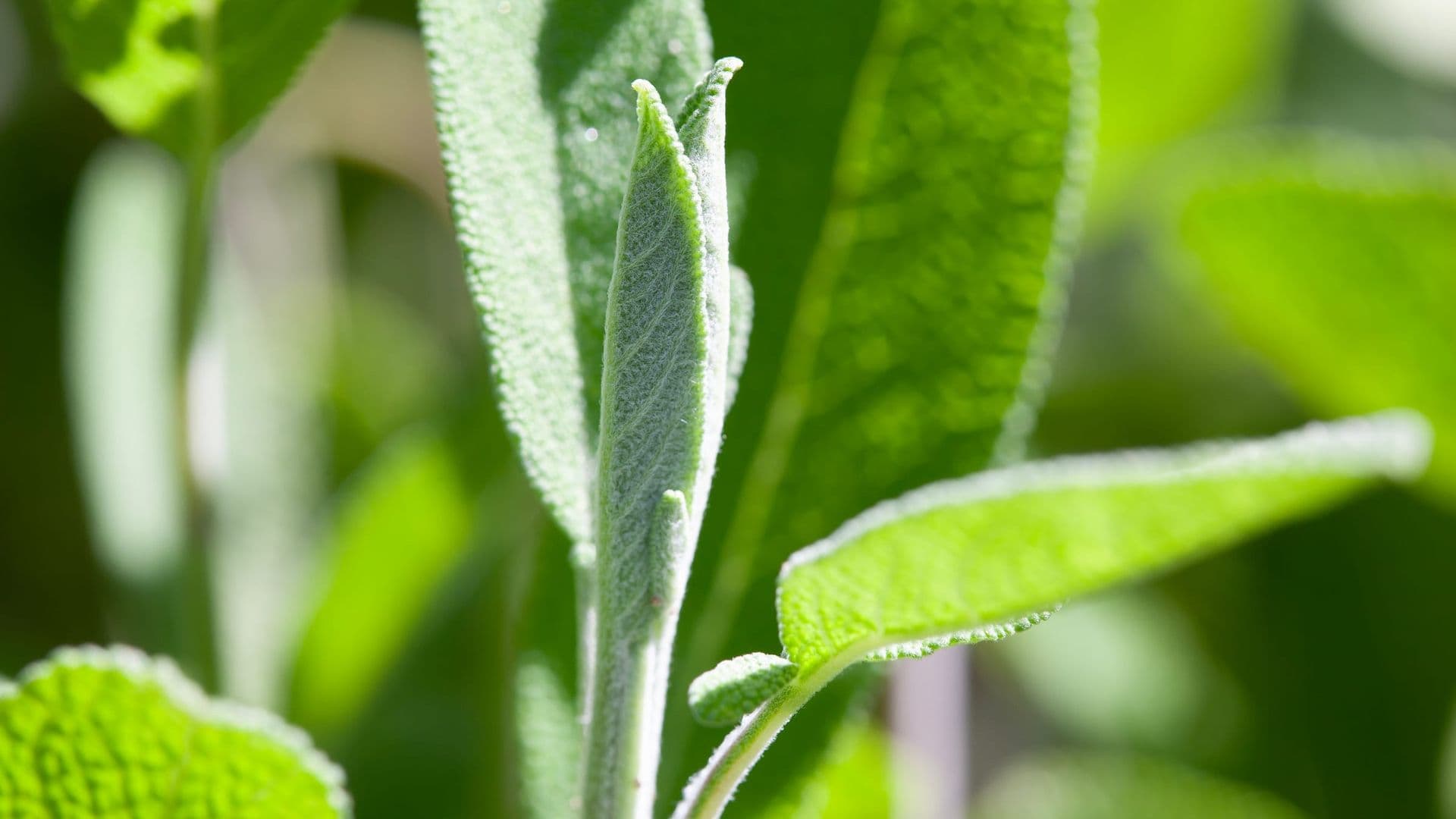
In the form of sage, we see a signature that fully corresponds to the perception of its scent. We find very soft leaves, which are grey-felted on the underside. They have a gentle, calm, rather cool colour tone, ranging between blue-green and grey-green. The leaves are steeply directed upwards in a receiving gesture.
The newly formed, topmost leaf of each stem is initially completely rolled up and thus forms a vertically standing tube. Later the leaf unfolds but remains half-tube-shaped and slightly rolled at the top throughout the vegetation period. The flowers of sage species have a characteristic feature. The stamens are movably attached in the corolla via a “trap-door mechanism.”
When a bee or bumblebee visits the sage flower, the upper stamen filaments move downwards, the anthers lower onto the body of the insect, and the pollen is brushed off. In this mechanism we recognise an essential connection between receiving and giving. Finally, it should be mentioned that the botanical name Salvia derives from the Latin salvare, to save. Sage has therefore enjoyed a high reputation as a healing medicinal plant since ancient times.
Organic cultivation
Sage originally comes from the northern Mediterranean region, especially the Dalmatian coastal area, and is now cultivated worldwide. It prefers dry, sunny, calcareous locations and tolerates drought excellently. In Switzerland, it is cultivated outdoors in Ticino, Valais and other warmer regions.
Ceres uses sage leaves from organic cultivation. The leaves are harvested shortly before flowering, when the vitality of the plant and its aroma are at their highest.
Traditional Use
Sage played an important role as a medicinal plant even in ancient times. Among others, sage was described by Hippocrates, Paracelsus and Hildegard of Bingen and was used early on for fever and acute illnesses, colic, and excessive sweating. Sage is still used today for the production of tinctures and various extracts. Based on long-standing use, sage is employed in traditional herbal medicine for internal and external application in inflammatory conditions of the mouth and throat, for dyspeptic complaints, as well as for increased sweat secretion. Corresponding preparations from sage are also used according to the homeopathic medicinal profile for disorders of sweat formation. Sage leaves are also used as food to season dishes or for tea preparations. Furthermore, essential oil is obtained from the leaves of sage by steam distillation. This is used to produce perfumes and mouthwashes.
Sources
1. Info Flora. Salvia officinalis L. https://www.infoflora.ch/de/flora/salvia-officinalis.html. Accessed March 25, 2020.
Open source2. Hänsel R, Steinegger E. Hänsel / Sticher Pharmakognosie Phytopharmazie. 10th ed. (Sticher O, Heilmann J, Zünddorf I, eds.). Wissenschaftliche Ver lagsgesellschaft GmbH, Stuttgart, Deutschland; 2015.
3. Madaus G. Madaus Lehrbuch Der Biologischen Heilmittel. mediamed verlag, Ravensburg; 1987.
4. Committee on Herbal Medicinal Products (HMPC). European Union herbal monograph on Salvia officinalis L., folium. EMA/HMPC/277152/2015. 2016.
5. BGA/BfArM (Kommission D). Salvia officinalis L. Bundesanzeiger. 1986;108 a. https://buecher.heilpflanzen-welt.de/BGA-Kommission-D-Monogra phien/salvia-officinalis.htm. Accessed March 24, 2020.
Open source6. Kalbermatten R, Kalbermatten H. Pflanzliche Urtinkturen. 7th ed. AT Verlag, Aarau, Schweiz; 2014.
7. Kalbermatten R. Wesen Und Signatur Der Heilpflanzen. 9th ed. AT Verlag, Aarau, Schweiz; 2016.
Ceres mortar process — gentle, cold and complete.
Freshly harvested, hand-picked, ground at room temperature and aged for years. No heating, no pressure - the plant's full vitality is preserved.