Ash
Fraxinus excelsior
Resilience, perseverance, tolerance, load-bearing capacity, purposefulness
Botany
Fraxinus excelsior L., the common ash, is a deciduous tree growing up to 40 m tall, belonging to the olive family (Oleaceae) and is one of the largest native broadleaf tree species. It can live for 200 to 300 years, favours moist locations, and tolerates prolonged flooding in riparian areas. It is a deep and vigorous rooter. Its wood combines elasticity, flexibility, strength, splinter resistance, and durability.
The greenish-grey bark is initially smooth, later becoming pale beige and longitudinally fissured. On its branches, the ash displays the typical dark brown winter buds. In spring, the flowers first unfold, in warm years as early as March. Only from April to May do the opposite, 20 to 35 cm long, odd-pinnate leaves with up to 15 lanceolate, sharply serrated leaflets develop. The ripe fruits are wind-dispersed. Young ashes are shade tolerant, while older ones are sensitive to shading. Ash dieback, caused by a fungus, now represents a major threat.
Essence of the plant
Resilience, perseverance, tolerance, load-bearing capacity, purposefulness
The human type represented by the ash tree is endowed with a tenacious perseverance. When they have a goal in mind, they can apply almost boundless endurance and patience to achieve it. They are not deterred by setbacks or failures; if something goes wrong, they see it as a task for optimisation, a new beginning, and immediately resume their work with great vigour.
To this end, they can withdraw and isolate themselves until the goal is reached. This is symbolised by the black buds of the ash tree. With their dark casing, they shield the interior from light to preserve it until the moment comes to bring it to light.
In archery, bow, arrow (both made of ash wood), and the drawn string merge into a unity. This image fits perfectly with the described person, who sets everything aside and tenses themselves for the sake of the targeted goal. The ash has a high load-bearing capacity; however, it does not place itself at the centre but remains modest. It is the prototype of a nature not focused on rapid success, for whom the goal is the most important.
The opposite of this behaviour can be found in people who have too little tension and too little goal orientation to succeed. They seek the blame in external circumstances or other people, brooding and getting upset about it, and rebel against it. It goes without saying that this behaviour brings health disadvantages in the long term.
Anger, grief, and the struggle against alleged obstacles lead to malfunctions in the body. Chronic inflammatory processes, rheumatic complaints, or polyarthritis may arise. Through its nature-typical tension, load-bearing capacity, and flexibility, the ash supplies the described human type with the necessary soul forces.
Fraxinus excelsior
Ash
From shape to healing power
Through its essence of tolerance and pliability, the ash tree supplies the described human type with the necessary soul forces. The ash is a widespread and common tree from the family of Oleaceae (which also includes the olive tree, lilac, jasmine, forsythia and privet). The wood of the ash is as hard as that of the oak, but unlike the oak, it is of the highest elasticity. It is therefore particularly suitable for handles of heavily used tools and for bows.
In earlier times, aeroplane propellers and skis were also made from it. Young people in rural areas sometimes amuse themselves by climbing young ash trees and then slowly lowering themselves to the ground while hanging from the top of the tree, which bends the whole small tree like a giant bow. What a cruel game with a tree – yet no other tree than the ash would endure this. Black ash buds; not striving for brilliance.
The bud is the most vital part of a plant. It contains the entire shoot or the entire flower in miniature form and urges to unfold. A bud harbours potential plant energy to the highest degree.
The colour that expresses this vitality is naturally green, like the leaves of most plants. Sometimes buds can also be red, thereby expressing an inherent warmth energy. Were it not for the ash showing us, black buds would be hard to imagine. The ash truly has black, velvety buds and thus differs markedly from other plants.
Black is not a colour, but the absence of it; black surfaces reflect no light, black swallows the life-giving light and is therefore very rare in the living natural world. We thus recognise an enormous contrast between the vitality inside the bud and its external colour. This contrast is all the more astonishing as the ash belongs to the most vital and vigorous trees. Could the ash’s essence be expressing through this contrast that its entire life force is placed at the service of others and not to the increase of its own brilliance?
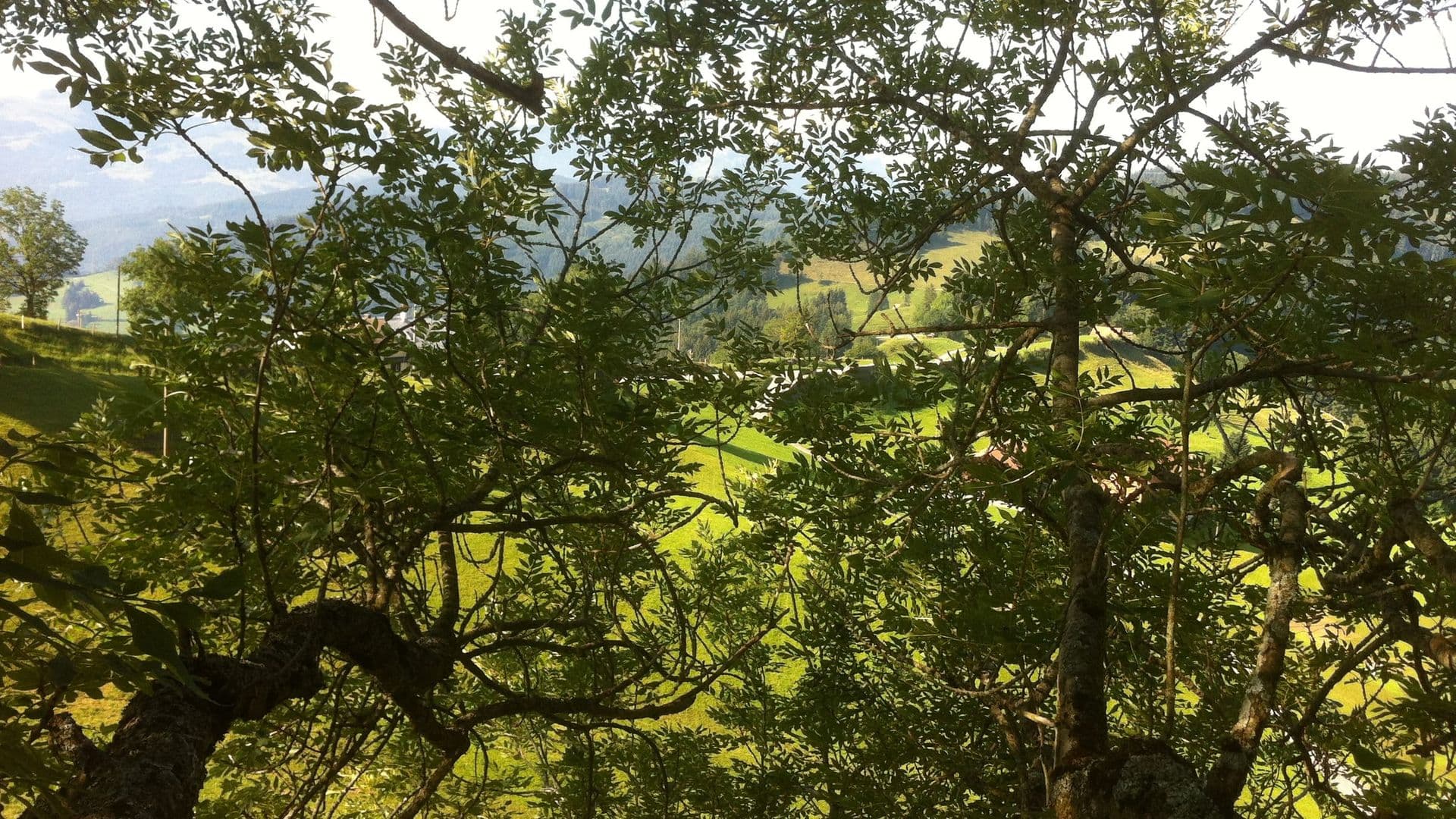
The ash leaves are pinnate with 9 to 13 lanceolate, finely toothed leaflets. The arrangement of the individual leaves follows a plan even in the mightiest ash crown, so that direct sunlight can still reach the ground. When viewed from below, the crown exhibits a uniform foliage with countless leaf spirals clearly visible.
Looking down again – on a sunny, not quite windless day – we can enjoy a game of dancing lights in the shade. That means other living beings residing in the influence of the mighty, protective ash are not standing in shadow; they have access to light and can unfold according to their nature. When the leaves fall in autumn, they leave striking scars on the branches. Branches of older trees are covered with such leaf scars.
During the decay process of ash leaves there is a remarkable, though unfortunately very rare and unknown to many healthcare professionals, phenomenon. Apparently, under special temperature and moisture conditions, decaying ash leaves can develop a wonderful, flower-like scent in February or March. I once experienced a whole forest filled with fragrance in this winter season. In the dissolution of life forces, it can happen that something rises from the ash leaf which points to the vitality of the coming summer.
Wild collection
Common ash is native throughout Europe and grows in forests, floodplains, on fresh to moist, nutrient-rich soils. It is one of the most common deciduous trees in Switzerland.
Ceres uses fresh ash leaves from wild collection in Switzerland. The young leaves are harvested in summer when they have developed the optimal aroma.
Traditional Use
Since antiquity, the ash tree has been described in literature and is firmly anchored in mythologies and legends. In Norse mythology, the ash tree is highly regarded as the all-encompassing world tree. Due to its rapidly regenerating hard wood and bark, which can be used for tanning and dyeing, the ash has been considered a very valuable plant for millennia. Its medicinal use has been known since the time of Hippocrates. Medicinally, the sap, leaves, roots, seeds, and bark were used. In addition to its application as an antidote for snake bites, the ash was already known at that time for the uses still established in complementary medicine today, such as a diuretic and antirheumatic agent.
Sources
1. Committee on Herbal Medicinal Products (HMPC). Assessment report on Fraxinus excelsior L. or Fraxinus angustifolia Vahl, folium. EMA/ HMPC/239269/2011 (2012).
2. Madaus, G. MADAUS LEHRBUCH DER BIOLOGISCHEN HEILMITTEL BAND 1-11. (mediamed Verlag, Ravensburg, 1990).
3. BGA/BfArM (Kommission D). Fraxinus excelsior. Bundesanzeiger 109 a, (1987).
4. Kalbermatten, R. & Kalbermatten, H. Pflanzliche Urtinkturen. (AT Verlag, Aarau, Schweiz, 2018).
5. Kalbermatten, R. Wesen und Signatur der Heilpflanzen. (AT Verlag, Aarau, Schweiz, 2016).
Resilience
R. & H. Kalbermatten — «Psyche des Menschen und Signatur der Heilpflanzen»
Ceres mortar process — gentle, cold and complete.
Freshly harvested, hand-picked, ground at room temperature and aged for years. No heating, no pressure - the plant's full vitality is preserved.