Angelica
Angelica archangelica
Demarcation between inside and outside, connection between top and bottom. Internal space, inspiration. Polarity of courage and fear.
Botany
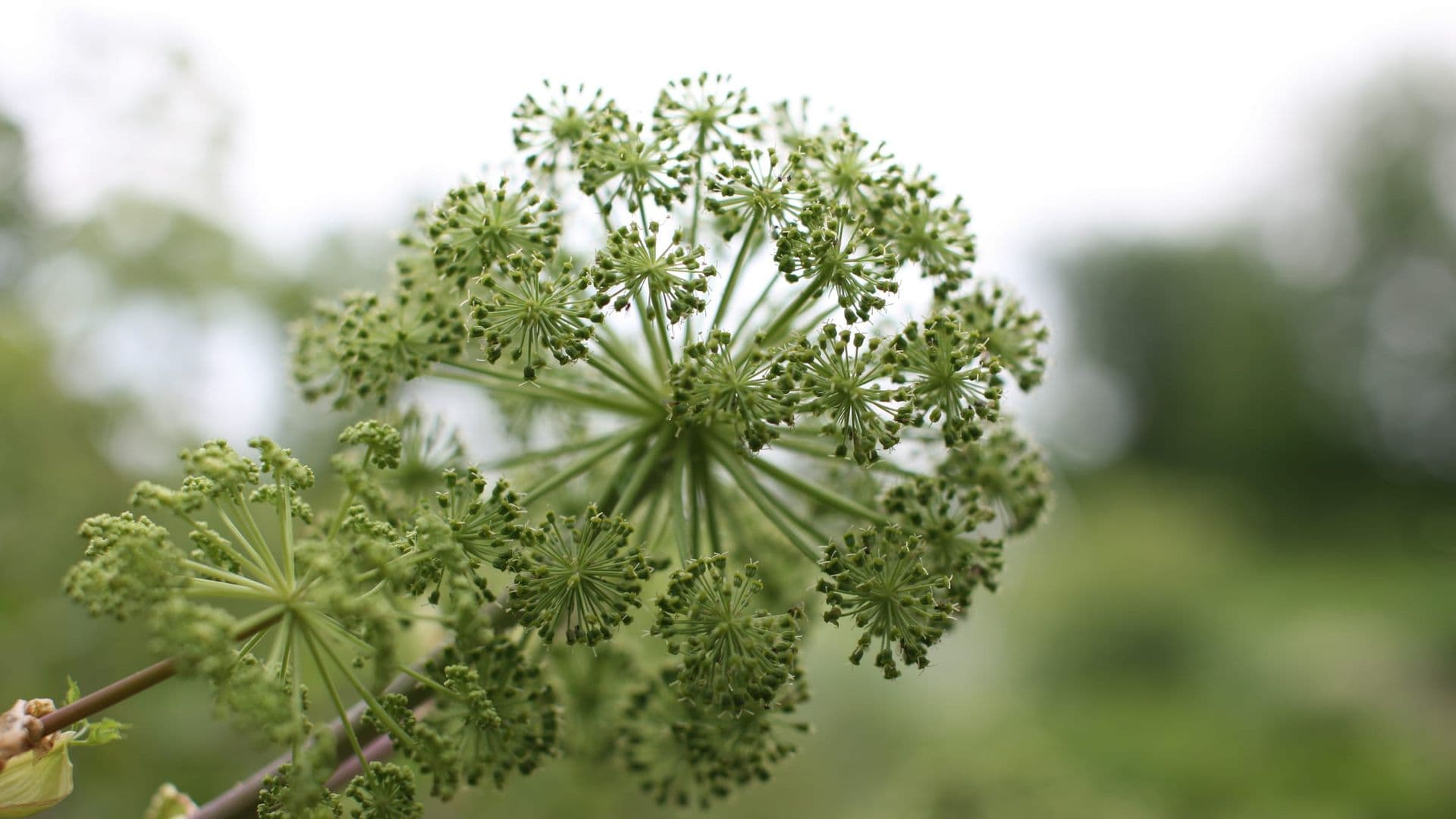
The True Angelica (Angelica archangelica L.) is a frost-hardy perennial. It usually lives for two to four years and flowers only once during this time. It belongs to the Apiaceae family and is primarily native to northern Europe. From its turnip-shaped root, which typically withers in the second year, Angelica forms an impressive plant that can grow to over 2.50 m in height. In the first year, it initially develops a rosette of large and imposing leaves. These can reach up to 90 cm in length and are twice to thrice pinnate. In the second year, the tall, upright stem then develops. This stem is hollow inside, round, finely grooved, and often tinged reddish-brown. It branches out towards the top. The leaves forming on the stem are smaller and less deeply divided than those lower down. At the end of the stem and its branches, the large, almost spherical double umbels form, bearing many greenish-yellow and yellowish flowers. The umbels can have a diameter of up to 20 cm. All parts of the plant emit a strong fragrance, particularly the aroma of the milky sap-bearing root.
Essence
Essence of the plant
Demarcation between inside and outside, connection between top and bottom. Internal space, inspiration. Polarity of courage and fear.
Angelica makes the inner space conscious, allowing the person to encounter their self. When this space is clogged by an excess of impressions, experiences and problems, the person is separated from the flow, the "flow". They are cut off from the source of strength and creativity, which can only flow in a free space.
They lose their identity and the necessary distance to maintain an overview amidst the complexity of everyday life. The connection to the whole and the view for simple solutions to problems is closed off. The essence of Angelica supports the formation of a protective shell to restore order between inside and outside, thereby reconnecting the upper with the lower.
The mind becomes clear for inspirations and innovative ideas, the connection between head, heart and gut, between heaven and earth is restored. Angelica shows the image of an upright person, well supported by their support system. Due to excessively rapid growth or rushing internal (e.g. hormonal) or external changes (family, work, ageing process), it can happen that the body threatens to overwhelm the soul. The patient experiences the feeling of "standing beside oneself" or "being outside oneself".
Angelica archangelica
Angelica
From shape to healing power
Angelica (Angelica archangelica) belongs to the family Apiaceae. The underground parts of the plant, which are used for the preparation of medicinal extracts, contain abundant essential oils with a strong, cleansing scent. The species of Apiaceae, as the family name suggests, have umbel-shaped inflorescences formed by the regular branching structure of the flower stalks, so that the many small individual flowers unite into umbels, which are hemispherically curved like umbrellas (the former family name Umbelliferae comes from the Late Latin umbella, meaning “parasol”). The umbels or umbrellas of this family can be regarded as part of a spherical surface.
What is special about the umbels of Angelica is that they do not only form part of a spherical surface, but almost perfect, complete spheres. The Angelica inflorescences thus create spherical cavities, which is unique in the plant kingdom. The spatial formation can be considered the characteristic feature, appearing not only in the flowers but also in the hollow stem and the distinctive bracts formed at the stem nodes, which envelop the leaf and flower buds like a protective covering. Another remarkable feature is the hexagonal cross-section of the roots.
Organic cultivation
Angelica is native to Northern Europe, Scandinavia, Iceland and northern Russia; it preferably grows in moist, nutrient-rich locations such as riverbanks, floodplains and wet forests up to mountainous regions. In Switzerland, it can be found in the Alps and Prealps at suitable sites.
Ceres uses Angelica from controlled organic cultivation. The roots are harvested in autumn.
Traditional Use
Folk medicine has known Angelica since ancient times. Almost all parts of the plant (flowers, leaves, and seeds, but especially the roots) have been used for digestive tract complaints, exhaustion, and respiratory ailments. The healing powers are said to have been revealed to humans by an angel. This suggests that the plant was attributed a connection to higher forces and provides a possible explanation for the protective effects described in literature against panic attacks or other anxiety disorders. Paracelsus already regarded Angelica as an effective remedy for flatulence. Hufeland valued its stimulating effect in states of weakness, and Madaus lists many more traditional indications for Angelica – however, the main focus is clearly on stomach and intestinal complaints. Medicinal preparations are prescribed as stomachics and carminatives. Use as an expectorant for lung conditions and as a tonic for nervous weakness is also common. In recent decades, the use of Angelica archangelica L. has primarily concentrated on its properties as an amarum aromaticum, cholagogum, and spasmolytic, often employed for complaints such as pain and burning in the upper abdomen, bloating, and flatulence. Thus, the Angelica root is also found in many bitter digestifs. Bitter remedies like Angelica are generally prescribed to stimulate saliva flow and the production of gastric and pancreatic juices in dyspepsia and loss of appetite.
Sources
1. Hänsel, R. & Steinegger, E. Hänsel / Sticher Pharmakognosie Phytopharmazie. (Wissenschaftliche Verlagsgesellschaft GmbH, Stuttgart, Deutschland, 2015).
2. Kommission E. Angelicae radix ( Angelikawurzel ). Bundesanzeiger 101, (1990).
3. Wichtl, M. et al. Teedrogen und Phytopharmaka. (Wissenschaftliche Verlagsgesellschaft GmbH, Stuttgart, Deutschland, 1997).
4. Madaus, G. MADAUS LEHRBUCH DER BIOLOGISCHEN HEILMITTEL BAND 1-11. (mediamed Verlag, Ravensburg, 1990).
5. Ruttkowski Beate. Stärker als jede Angst: Ein Leitfaden zur Selbstbehandlung mit Homöopathie, Blüten-Essenzen und Heilpflanzen. (S. Fischer Verlag, 2015).
6. Kalbermatten, R. & Kalbermatten, H. Pflanzliche Urtinkturen. (AT Verlag, Aarau, Schweiz, 2014).
7. Kalbermatten, R. & Kalbermatten, H. Psyche des Menschen und Signatur der Heilpflanzen. (AT Verlag, Aarau und München, 2020).
The emotional freedom and identity
R. & H. Kalbermatten — «Psyche des Menschen und Signatur der Heilpflanzen»
Ceres mortar process — gentle, cold and complete.
Freshly harvested, hand-picked, ground at room temperature and aged for years. No heating, no pressure - the plant's full vitality is preserved.