Yellow Gentian
Gentiana lutea
Surmounting, digestion, fragmentation
Botany
The Yellow Gentian (Gentiana lutea L.) is a perennial herb growing up to 140 cm high, belonging to the family of gentians (Gentianaceae). The imposing plant can live up to 60 years in its natural habitat in the mountains of Central Europe. From a large, often multi-headed, transversely grooved rhizome it produces a smooth root up to 1 m long; the fresh weight of the underground parts of a single plant can reach up to 7 kg.
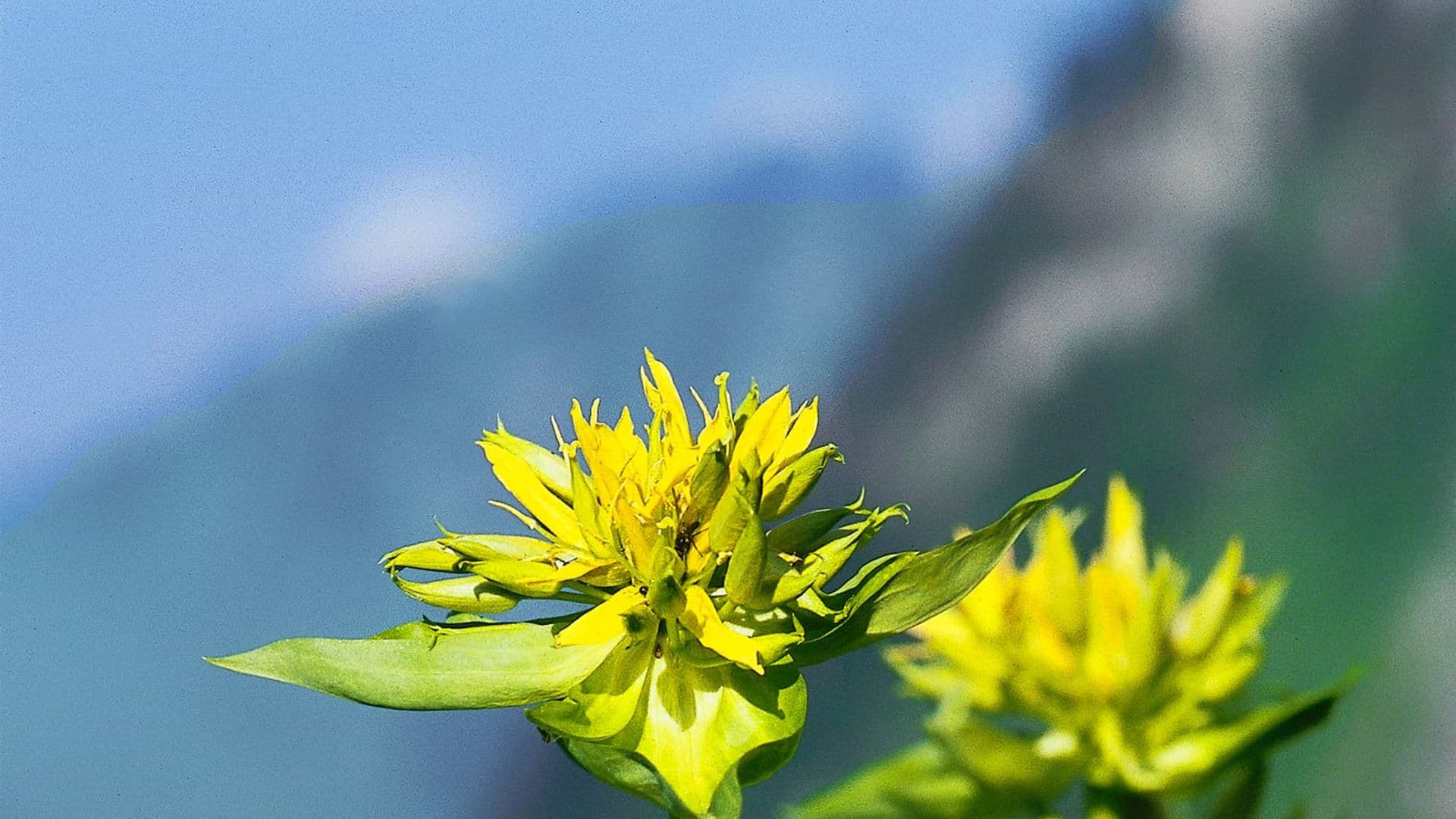
Above ground, initially only a basal rosette of elliptical leaves develops. The opposite pairs of blue-green leaves are broadly elliptical, spoon-shaped and curved inward with parallel veins. From June to August, yellow flowers — beautiful stars arranged in 3 to 7 tiers in false whorls — form in the cup-shaped leaf axils. When not in flower, the gentian can be mistaken for the poisonous White Hellebore (Veratrum album) — however, its leaves are alternate, not opposite.
Essence of the plant
Surmounting, digestion, fragmentation
The digestive process and the processing of emotional impressions share many similarities. In both cases, the ingested alien substances and energies must be overcome and processed, assimilated. If moving events or images are emotionally difficult to digest, there is usually also an organic digestive weakness.
Often, feelings or foods then sit heavily on the stomach, resulting in a strong pressure in the stomach area. Gentian possesses the essential strength to overcome and break down the foreign, thereby supporting both physical and emotional digestion. Gentian is especially helpful for the digestion of protein.
Gentiana lutea
Yellow Gentian
From shape to healing power
When we hear the name gentian, we usually think of beautiful, deep blue flowers that adorn our alpine meadows like small bells. The blue gentian is undoubtedly the epitome of the mountain flower. However, the medicinal plant gentian is of a very different kind. As its name suggests, its flowers are yellow, and with a height of up to 1.2 m, it is also a very stately plant.
The yellow gentian has oval leaves up to 30 cm long and 15 cm wide, with prominently raised veins. The leaves resemble those of the very poisonous white hellebore (Veratrum album), which can lead to dangerous confusions. However, due to the opposite leaf arrangement, gentian can be easily distinguished from hellebore, whose leaves are alternate. The upper leaves of the yellow gentian are curved like half-shells.
At first, these shells surround the stem and conceal the flower buds inside them. When the leaf shells open and lay horizontally, they release a large number of flowers. These have a form completely untypical for the gentian genus. The petals of other gentian species are fused from the base well beyond the middle, forming bell- or tube-shaped flowers.
The flowers of the yellow gentian, by contrast, are almost divided right down to the base. Furthermore, the petals are narrow and long, so that when fully open, they appear as separate, distinct elements rather than the typical gentian flower, and resemble five- to six-pointed stars. Since the inflorescence of the yellow gentian is also composed of numerous individual flowers looking in various directions, it appears very heterogeneous, if not chaotic. We clearly recognise that a strongly dividing essence has played a role in its formation. The leaves enveloping the stem with the flower buds inside can be regarded as a solid unit, within which – in the flowers – a dividing principle is at work.
This dividing power is also evident in the mighty roots. They can be described as many-headed, whereby the individual parts continually entwine with one another. An inward consideration of the essence of this plant reveals a kinship with the nature of the bovine. The cow is the animal whose essence is probably most strongly oriented towards digestion.
The cow is digestion made animal. The shape of the bovine is relatively block-like, and within this block acts the dividing force of digestion. Gentian can almost be described as a wonder remedy for the breakdown of indigestible cow’s milk products, such as warm dishes made from cheese like pizza, raclette or fondue. Gentian is probably the most potent medicinal plant for supporting digestion.
Wild collection
Yellow gentian is native to the mountains of Central and Southern Europe (Alps, Pyrenees, Apennines, Balkan Peninsula) and grows on mountain meadows, pastures, and limestone formations between 800 and 2500 metres.
Ceres sources gentian root from controlled wild collection in Switzerland.
Traditional Use
For centuries, the root of yellow gentian, Gentiana lutea L., has been recognised as a bitter stomach and gall remedy, as well as a general tonic. There is a remarkably strong agreement between the recommendations of traditional herbal authors and the latest scientific studies regarding gentian. The bitter gentian stimulates the secretion of saliva, gastric juice, and bile. Its areas of application thus include digestive complaints such as loss of appetite, a feeling of fullness, and flatulence. Less well known is the fact that the uses of bitter-tasting medicinal plants extend beyond digestive problems. By stimulating the appetite, gentian can be used as a bitter remedy to strengthen the body after prolonged illness or in cases of anorexia. The perception of bitter substances through the digestive system also involves the central nervous system and the entire organism. Thus, its use may also be justified for depressive moods and general strengthening.
Sources
1. Hänsel, R. & Steinegger, E. Hänsel / Sticher Pharmakognosie Phytopharmazie. (Wissenschaftliche Verlagsgesellschaft GmbH, Stuttgart, Deutschland, 2015).
2. BGA/BfArM (Kommission E). Gentianae radix (Enzianwurzel). Bundesanzeiger 223, (1985).
3. Madaus, G. MADAUS LEHRBUCH DER BIOLOGISCHEN HEILMITTEL BAND 1-11. (mediamed Verlag, Ravensburg, 1990).
4. Committee on Herbal Medicinal Products (HMPC). Assessment Report on Gentiana Lutea L., Radix. EMA/HMPC/607863/2017 (2018).
5. BGA/BfArM (Kommission D). Gentiana lutea. Bundesanzeiger 217 a, (1985).
6. Saller, R., Melzer, J., Uehleke, B. & Rostock, M. Phytotherapeutische Bittermittel. Schweizerische Zeitschrift fur GanzheitsMedizin 21, 200–205 (2009).
7. Kalbermatten, R. & Kalbermatten, H. Pflanzliche Urtinkturen. (AT Verlag, Aarau, Schweiz, 2018).
8. Kalbermatten, R. Wesen und Signatur der Heilpflanzen. (AT Verlag, Aarau, Schweiz, 2016).
Power of Sharing
R. & H. Kalbermatten — «Psyche des Menschen und Signatur der Heilpflanzen»
Ceres mortar process — gentle, cold and complete.
Freshly harvested, hand-picked, ground at room temperature and aged for years. No heating, no pressure - the plant's full vitality is preserved.