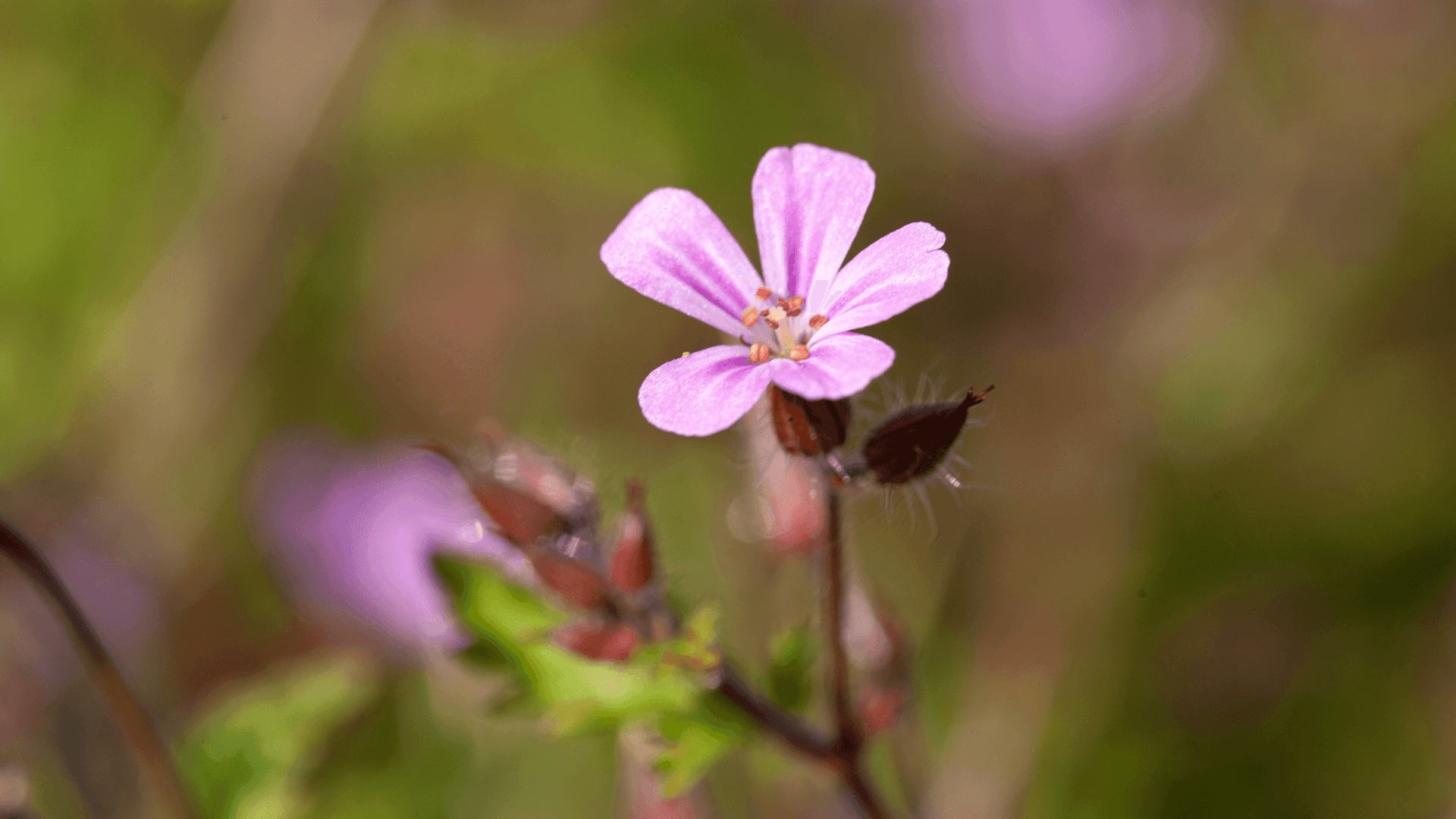
Storksbill
Geranium robertianum
Drawing, purifying, detoxifying, resolving states of shock, lymph remedy
Botany
Geranium robertianum, the Stinking Crane's-bill, belongs to the Crane's-bill family (Geraniaceae). This species is widespread in herb-rich woods, ravines, on walls, rocks, and in towns — often in less pleasant places such as backyards or neglected, dirty areas. The plant is annual or biennial. After germination, rosette leaves develop that usually wither quickly. The ascending shoots are up to 1 cm thick, juicy, sparsely branched and show strongly thickened nodes at which they break off easily.
The entire shoot is densely covered with elongated, reddish glandular hairs responsible for the pungent, often unpleasant odour. The stem leaves are opposite and composed of 3 to 5 completely separate, pinnately cleft leaflets. In strong sunlight, leaves and shoots turn reddish. Geranium robertianum blooms from May until autumn with pale purple flowers. After flowering, the typical 2 cm long fruits develop, shaped like a crane's bill with a red tip. When the above-ground parts are pulled, they separate easily — the plant is not truly anchored in the soil. Only a small, thin rootlet connects it to the ground.
Essence of the plant
Drawing, purifying, detoxifying, resolving states of shock, lymph remedy
Geranium has an astringent, cleansing and detoxifying effect, especially concerning toxins that enter the body suddenly and usually through external influences, such as insect poisons. Analogous “poisonings” also occur on the emotional level through the experience of mental or physical violence or as a result of traumatic experiences such as an unexpected severe loss. These can act like a kind of psychological poison, causing emotional paralysis and apathy.
In such conditions, Geranium intervenes effectively. In acute shock states, resolution is possible with Geranium within a very short time. On the physical level, Geranium has a specific, activating effect on lymph flow.
When a person is in shock due to a traumatic experience, the subtle bodies loosen; they no longer interlock concentrically. This is the cause of the temporary, more or less severe loss of memory and/or consciousness.
In this loosened state, the soul is unprotected and open, allowing external forces to influence it. Even long-past traumatic experiences can cause a blockade on the psychological and physical level for years, such that even well-chosen therapies do not work properly. These conditions are occurring more frequently.
For this reason, Geranium is one of the most important medicinal plants of our time. Its essence effects the reunion of the loosened subtle bodies (astral and etheric bodies) with the dense physical body; consciousness actively re-engages with life once more. Geranium withdraws bodily and soulful toxins and, through this purification of the terrain, enables a new beginning.
Geranium robertianum
Storksbill
From shape to healing power
This video is provided by YouTube and requires your consent.
Since my childhood, I have repeatedly noticed a plant that grows in places where one does not feel very comfortable, for example in a mossy backyard in the old town, surrounded by the smell of stale cat urine and woodlice that panicingly flee the light from beneath lifted stones or boards... Later I learned the name of this plant: Ruprechtskraut. Of course, it can also be found in beautiful locations, in forests or in damp, shady spots under bushes. What is striking, however, is how often Ruprechtskraut is found in places with impure atmospheres.
In keeping with its choice of location, Ruprechtskraut also has an unpleasant odour. This is reflected in its other name, Stinking Stork’s-bill. Ruprechtskraut belongs to a genus (Geranium) that usually produces pleasantly scented species. Some Geranium species have a scent akin to roses.
Many cosmetic products that claim to have a rose perfume actually contain the cheaper geranium oil. Against this background, it is particularly significant that Ruprechtskraut emits a dissonant odour. This odour must be understood in the context of its site preference. When a plant seeks atmospherically impure sites, this means it requires and processes the energy present there. The unpleasant smell of the plant is a sign that it absorbs atmospheric energetic disharmonies and – transformed on a substantial level – subsequently releases them again.
Another distinctive feature of the signatory is the red colouring at the tip of the Stork’s-bill. Like all members of the Geranium family, Geranium robertianum has a long, pointed fruit. What is special about this plant is that this tip is coated in blood-red, allowing an association with a stabbing weapon or an insect sting in action. This expresses the element of suddenness, of surprise attack.
Anyone who has Geranium robertianum in their garden and tries to pull it out will find this completely easy. A light tug, barely noticeable resistance, and you hold the whole plant with its root in your hand. On closer examination, we observe how little Ruprechtskraut is anchored in the soil. The upper part of the root is in the air.
Then comes a thin, horizontal root that lies just below the soil surface. Sometimes the root is exposed between a layer of leaves and the forest floor, and only a few lateral rootlets are connected to the earth. (The plant does not have a taproot as indicated in some botanical works.) However, such a weak root could not possibly support the rather expansive plant. The root therefore only serves the function of supplying water and mineral salts and does not provide fixation for the plant. The fixation happens in an absolutely unique manner. The plant is supported on the ground by modified leaf stalks.
The stalks of the lower leaves undergo a significant change after the leaf blade dies. They begin to grow again, bend downward and then slightly upwards at the tip. Thus, the former leaf stalks of the lower leaves (in older plants also those of previous years) form arch-shaped supports on which the Stork’s-bill stands. If the plant is gently pulled upward, the supports lift off the ground.
The plant is therefore not firmly connected to the earth but rests on it and can ‘lift off’ anytime. Another striking feature is the strong knotty thickenings at the points where the leaves emerge. Since this corresponds also with inner perception, I here exceptionally draw a comparison between these nodules and lymph glands. As mentioned in the general part, I am usually very cautious with such direct comparisons between plant and organ forms.
Organic and Demeter cultivation
Ruprechtskraut is widespread in Europe, North Asia and North America, growing as an undemanding shade plant in forests, hedges, walls and gardens.
Ceres uses Ruprechtskraut from organic and Demeter cultivation in Switzerland. The fresh, flowering herb is harvested in spring when, besides the small flowers, some fruits have already developed.
Traditional Use
Geranium robertianum L. is already found under the name Herba Roberti in the herbal books of the 16th century. Saint Hildegard of Bingen describes a stork's-bill (storchesnabel, storkesnabil) in her works «Physika» and «Causa et Curae». It is used together with other ingredients as a universal remedy against "poison and spells", to promote expectoration, for stone complaints, as well as heart conditions and sadness. Overall, botanists of the late Middle Ages largely agreed on the useful, healing properties of the stork's-bill. According to traditional usage recommendations, Geranium robertianum L. is used in folk medicine primarily in these three areas due to its astringent properties: bleeding, diarrhoea and skin diseases. Furthermore, homeopathic literature describes applications for shock and anxiety states, panic, (lymph node) swelling and activation of lymph flow for detoxification, e.g. after tick bites and as an accompaniment to borreliosis therapy, psychological paralysis states and melancholy as a consequence of fright and trauma.
Sources
1. Madaus, G. MADAUS LEHRBUCH DER BIOLOGISCHEN HEILMITTEL BAND 1-11. (mediamed Verlag, Ravensburg, 1990).
2. Hänsel, R., Keller, K., Rimpler, H. & Schneider, G. Hagers Handbuch der pharmazeutischen Praxis Band 5 Drogen E-O. (Springer-Verlag Berlin Heidelberg 1993, 1993).
3. Kalbermatten, R. & Kalbermatten, H. Pflanzliche Urtinkturen. (AT Verlag, Aarau, Schweiz, 2018).
4. Riha, O. Hildegard von Bingen - Werke - Band II - Ursprung und Behandlung der Krankheiten - Causa et Curae - Vollständig neu übersetzt und eingeleitet. (Beuroner Kunstverlag (Abtei St. Hildegard, Rüdesheim/Eibingen), 2016).
5. Riha, O. Hildegard von Bingen - Werke- Band V- Heilsame Schöpfung - Die natürliche Wirkkraft der Dinge - Physica - Vollständig neu übersetzt und eingeleitet. (Beuroner Kunstverlag (Abtei St. Hildegard, Rüdesheim/Eibingen), 2016).
6. Vermeulen, F. & Johnston, L. Plants Homeopathic and Medicinal Uses from a Botanical Family Perspective Volume 1-4. (Saltire Books Ltd, Glasgow, Scotland, 2011).
7. Kalbermatten, R. Wesen und Signatur der Heilpflanzen. (AT Verlag, Aarau, Schweiz, 2016).
The Anchoring of the Root of Life
R. & H. Kalbermatten — «Psyche des Menschen und Signatur der Heilpflanzen»
Ceres mortar process — gentle, cold and complete.
Freshly harvested, hand-picked, ground at room temperature and aged for years. No heating, no pressure - the plant's full vitality is preserved.