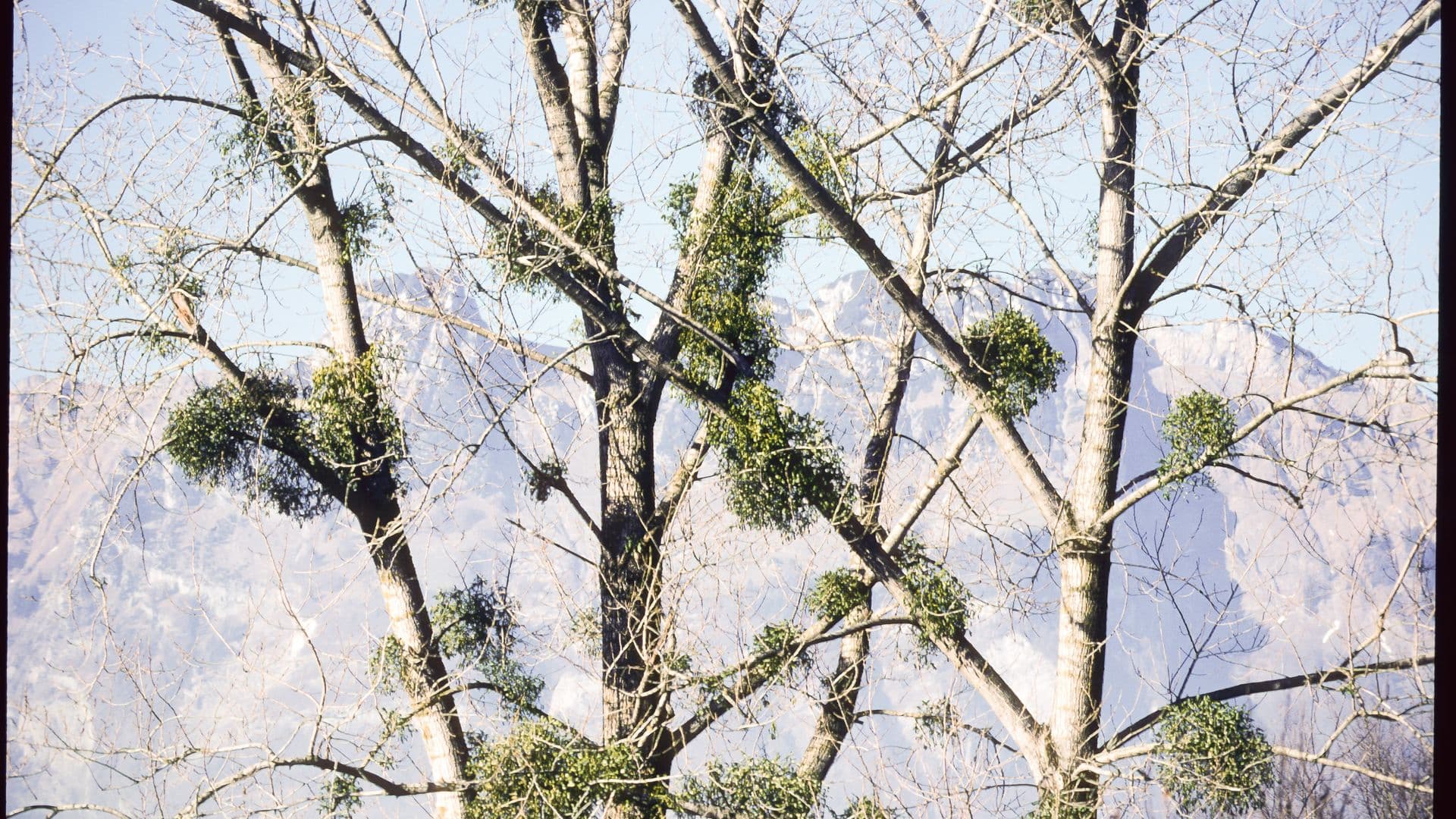
Winter
Mistel
Viscum album
Silence, weightlessness
familySantalaceae (Sandalwood family)
LocationOn deciduous trees (especially apple trees, poplars, lime trees); hemiparasite
HarvestNovember
ProcessingMortar method
Botany and nature of the plant
Botany
A very special plant we encounter is the mistletoe (Viscum album L.). It stands out especially in winter, as it remains green then. It is a globular-growing shrub that never touches the ground throughout its life: the mistletoe grows on deciduous trees. It grows very slowly; old plants can reach a diameter of 100 cm after decades. Its sticky fruits are dispersed by birds and remain stuck to the bark of trees. After sprouting, the seed pierces the bark with a haustorium and connects to the host's vascular system. Through this, the mistletoe withdraws water and nutrients from its host tree; it carries out photosynthesis itself.
The shoots branch forkedly — an unusual form for Central European plants. On the short branches are the dark green, leathery, elongated leaves (up to 8 cm long). The inconspicuous yellow-green flowers appear from February to April, often even before the leaves of the host trees have developed. Flower formation ends growth for the year — therefore the age can be easily determined: each fork segment corresponds to one year of growth. After fertilisation, the white, longitudinally striped fruits develop with mucilaginous-sticky pulp, which only ripen in November or December.
Nature of the plant
Silence, weightlessness
Mistletoe is subject to the water and air elements and entirely escapes the sphere of influence of earth and fire. Applied to humans, the elements air and water correspond to feelings and life energy. Differences in pressure and tension in the atmosphere naturally arise through the effects of heat and gravity. Since mistletoe is not affected by heat and earthly forces, it keeps pressure and tension away from its sphere of action; stress, tense feelings, and a fiery temper are foreign to the essence of mistletoe.
As such emotional states are often a common cause of hypertension, a connection between the essence of mistletoe and its physical, blood pressure-lowering effect is evident. Viscum album conveys a feeling of inner silence and weightlessness. Patients with anxiety disorders, nightmares and/or an excessive sensitivity to lunar influences respond well to treatment with the mother tincture in low dosage.
Viscum album
Mistel, Weisse Mistel
familySantalaceae (Sandalwood family)
Height20–100 cm Durchmesser (Halbparasit auf Bäumen)
Flowering periodFebruary–April
Harvest monthsNovember
LocationOn deciduous trees (especially apple trees, poplars, lime trees); hemiparasite
DistributionEurope, Western Asia; common in lower altitudes in Switzerland
Ceres procurementWild collection
Plant partFresh plant at the time of fruit ripening
Common namesWeisse Mistel, Laubholz-Mistel, Drudenfuss, Mistletoe
Signature & impact
From shape to healing power
Mistletoe is an evergreen, shrub-like hemiparasite on trees. The branches fork dichotomously, meaning that at the points of branching, new branches of equal size (usually two) always form. This type of branching leads to the typical spherical shape of mistletoe. The mistletoe balls can reach up to 1 m in diameter.
The younger branches are green-brown. The entire, tongue-shaped leaves are olive green and mostly sit in pairs opposite each other, less commonly in whorls, at shoot tips or at younger branching points. At the end of each forked segment is a flower-bearing tip, which in autumn and winter carries pea-sized white fruits. These are very mucilaginous and sticky.
When we compare mistletoe with the plant’s characteristic form, a striking deviation becomes apparent. Mistletoe does not orient itself according to gravity. Normally, a plant directs its roots downwards into the soil and the stem upwards, in the opposite direction. This demonstrates an effect of the earth’s force on plants.
For mistletoe there is no top or bottom in growth; rather, it expands completely spherically. It only recognises its own centre as a reference point and pays no heed to gravity. The white mistletoe berries are very sticky. Also, the sunlight does not seem to cause the usual differentiation in the plant’s shape.
Mistletoe does not develop any fragrances, flavours, colours, or differentiated flowers, fruits, or leaf forms that would indicate a light effect. Mistletoe has the simplest possible forms: forked branches, oval leaves, spherical fruits. This suggests that primarily air and water forces influenced its shaping. Water forces form the leaves, and air forces structure the plant through branching.
Harvest timeNovember
ProcurementWild collection
Origin & harvest
Wild collection
The mistletoe is a hemi-parasite that grows on various deciduous and coniferous trees (especially apple, oak, pine, fir) in Europe and Western Asia. It forms spherical, evergreen bushes and prefers sunny locations in the tree canopy.
Ceres uses mistletoes from wild collection in Switzerland. Mistletoes are collected from tall standard trees (apple). The harvest is carried out by hand at fruit ripening in early winter.
Historical context
Traditional Use
Mistletoe, Viscum album L., is a very special cultural and medicinal plant to which magical and luck-bringing properties are attributed. During the Christmas season, mistletoe sprigs are often seen in the doorframes of many houses. As a medicinal plant, mistletoe has traditionally been used for various cardiovascular complaints, especially high blood pressure, dizziness, and heart rhythm disorders. The Romans made a substance called birdlime from the mistletoe berries. This was spread on branches to catch attracted birds. You can experience this sticky property yourself by crushing mistletoe berries between your fingers.
Sources
1. Hänsel, R. & Steinegger, E. Hänsel / Sticher Pharmakognosie Phytopharmazie. (Wissenschaftliche Verlagsgesellschaft GmbH, Stuttgart, Deutschland, 2015).
2. Madaus, G. MADAUS LEHRBUCH DER BIOLOGISCHEN HEILMITTEL BAND 1-11. (mediamed Verlag, Ravensburg, 1990).
3. Committee on Herbal Medicinal Products (HMPC). Assessment report on Viscum album L ., herba. EMA/HMPC/246778/2009 (2012).
4. BGA/BfArM (Kommission D). Viscum album. Bundesanzeiger 217a, (1985).
5. BGA/BfArM (Kommission E). Visci albi herba (Mistelkraut). 1Bundesanzeiger 228, (1984).
6. Kalbermatten, R. & Kalbermatten, H. Pflanzliche Urtinkturen. (AT Verlag, Aarau, Schweiz, 2018).
7. Kalbermatten, R. Wesen und Signatur der Heilpflanzen. (AT Verlag, Aarau, Schweiz, 2016).
Manufacturing
Ceres mortar process — gentle, cold and complete.
Freshly harvested, hand-picked, ground at room temperature and aged for years. No heating, no pressure - the plant's full vitality is preserved.